
Introduction
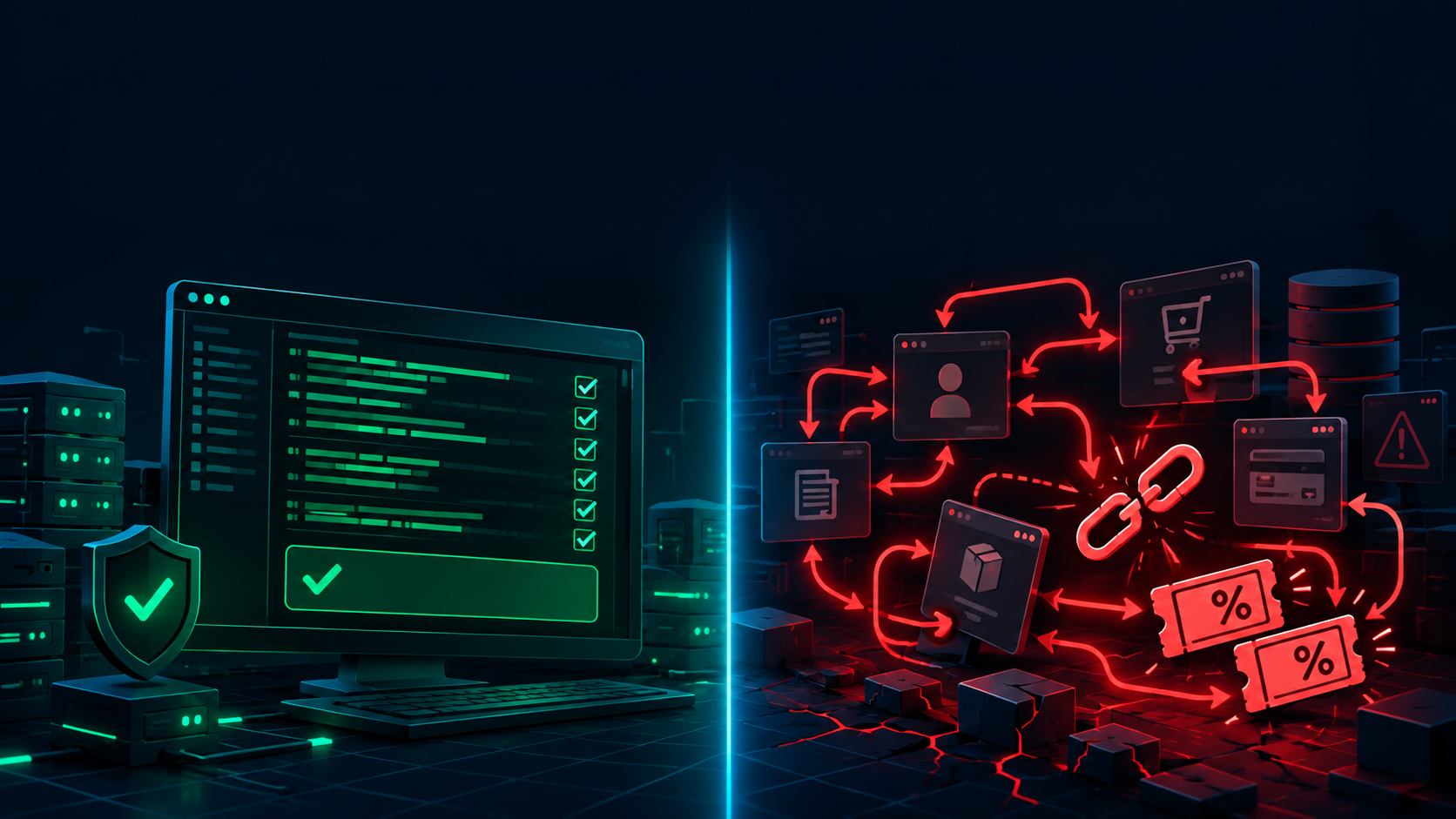
You can run Burp Suite, DAST scanners, SAST tools, API scanners, vulnerability scanners, and hundreds of automated checks against an application - and still miss a vulnerability that can cost the business money, bypass an approval process, or completely break a transaction workflow.
Why?
Because sometimes the vulnerability isn't in the input. It's in the logic.
Imagine testing an e-commerce application. You discover that a user can apply a discount coupon through an API. Nothing unusual happens when you fuzz the parameters. The endpoint is authenticated. Authorization works. Input validation is present.
Then you send the same coupon request twice.
The discount is applied twice.
The application has no SQL injection, no XSS, no obvious access-control bypass. The request itself is perfectly valid. The problem is that the application allowed a legitimate operation to happen in a way the business never intended.
This is the territory of business-logic abuse - and it is one of the areas where manual penetration testing and human reasoning remain extremely important.
At QuassrCyberTech, this is one of the patterns our offensive security team runs into on nearly every engagement - not from a scanner, but from a tester who understands how the business is supposed to work.
What Is a Business-Logic Vulnerability?
Business logic is the collection of rules that determine how an application is supposed to operate.
- A coupon can only be used once.
- A user can withdraw money only if sufficient balance exists.
- An employee cannot approve their own request.
- A refund can only be issued after a successful payment.
- A free trial can only be claimed once.
- A transaction cannot be completed before identity verification.
- An order cannot move from cancelled back to paid.
- A user can create a maximum of five projects.
These aren't necessarily technical security controls. They are business rules.
A business-logic vulnerability occurs when an attacker can manipulate the application's workflow, state, data, or sequence of operations to violate one of those rules.
The interesting part is that the attacker may not need an unusual payload at all. They may simply need to perform legitimate actions - Create, Modify, Cancel, Replay, Approve, Repeat - but in an unintended combination or sequence.
Why Automated Scanners Struggle
Automated scanners are extremely effective at finding patterns. They can test thousands of parameters for SQL injection, XSS, command injection, path traversal, SSRF, and other technical vulnerabilities.
Business logic is different because the scanner needs to understand intent and context. Consider this API endpoint:
POST /api/order/apply-couponA scanner can discover the endpoint, identify the coupon parameter, and test whether the parameter accepts unexpected input. But the important question is:
What should happen if the same valid coupon is submitted three times?
That answer depends entirely on the application's business rules - it could be completely legitimate, a functional bug, a financial vulnerability, or a critical business-impact issue. The technology alone doesn't provide the answer. The tester needs to understand the application's intended workflow.
That is precisely the gap that makes business-logic testing so important.
OWASP's Business Logic Abuse Top 10
This problem has received more formal attention with the OWASP Top 10 for Business Logic Abuse, introduced as an OWASP community project and first released at OWASP AppSec Global EU in Barcelona in May 2025.
The published taxonomy contains ten classes:
- Lifecycle and Orphaned Transitions Flaws
- Logic Bomb, Loops and Halting Issues
- Data Type Smuggling
- Sequential State Bypass
- Data Oracle Exposure
- Missing Roles and Permission Checks
- Transition Validation Flaws
- Replays of Idempotency Operations
- Race Condition and Concurrency Issues
- Resource Quota Violations
The taxonomy gives security practitioners a common vocabulary for problems that historically have been described using many different terms. Several of these categories directly map to situations penetration testers encounter during API and web application assessments.
1. Sequential State Bypass
Many applications expect users to follow a specific sequence. Consider a KYC workflow:
Register -> Email Verification -> Identity Verification -> KYC Approval -> Account ActivationA normal user follows the workflow. But an attacker may inspect the API calls and discover:
POST /api/kyc/verify
POST /api/account/activate
The question becomes: does the backend actually enforce the sequence?
If the attacker can directly invoke the activation operation without completing the preceding requirements, the application has a workflow problem. The frontend may prevent the user from clicking "Activate Account." The API may not.
A penetration tester should therefore test the backend independently from the UI. The expected path is Step 1 - Step 2 - Step 3. Then test: Step 1 - Step 3, Step 3 - Step 1, Step 2 - Step 3, and Step 3 directly.
The objective is not simply to break the application. It is to determine whether the server validates the state in which an operation is being performed.
2. Payment Manipulation
Payment functionality is one of the richest areas for business-logic testing. Suppose the application sends:
{
  "product_id": 1001,
  "quantity": 1,
  "price": 999
}
A tester should immediately ask: is price an instruction from the client, or should the server calculate it? If the backend trusts the client-controlled price, changing "price": 999 to "price": 1 could produce a serious financial impact.
But payment manipulation doesn't stop at changing prices. The full surface includes quantity manipulation, currency manipulation, discount manipulation, tax manipulation, shipping manipulation, refund manipulation, payment-status manipulation, and transaction replay.
A particularly interesting scenario is when the application separates payment from order completion:
Create Order -> Initiate Payment -> Payment Gateway -> Payment Confirmation -> Order CompletedWhat happens if the tester attempts to reach the final step without a valid payment? Or replays the payment confirmation? Or modifies the transaction identifier? Or changes the amount between the payment-initiation and confirmation stages? These are the questions a business-logic assessment should answer.
3. Coupon Abuse
Coupons are a classic example. Suppose the business rule says: one coupon per customer.
The implementation might look correct during normal testing. The tester applies SAVE20 - the discount works, nothing suspicious happens.
Now consider these scenarios:
- Apply SAVE20 twice
- Apply SAVE20 after order modification
- Apply two incompatible coupons
- Apply an expired coupon
- Reuse a coupon from another account
- Apply a coupon after cancellation
- Replay the coupon request
Each request may individually look completely legitimate. The vulnerability appears when the application's state is examined across multiple requests. For example - an order of $100 becomes $80 after SAVE20, and $60 after SAVE20 a second time. The application has effectively allowed the attacker to violate the intended discount rule.
This is why business-logic testing is often about relationships between requests, rather than individual requests.
4. Race Conditions
Race conditions become especially interesting when the application performs a check-decide-update sequence.
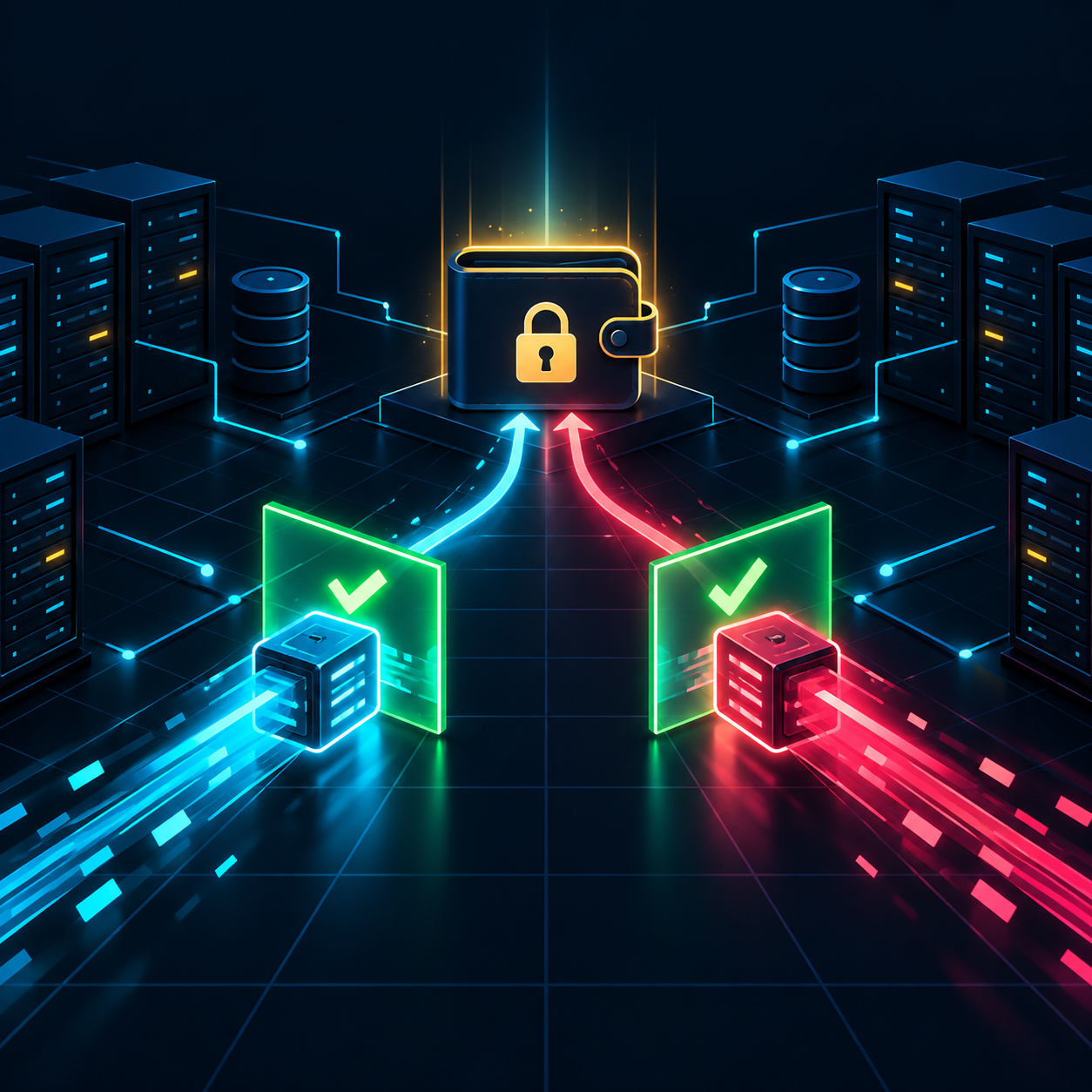
Consider a wallet with a balance of Rs. 1,000. Two withdrawal requests arrive almost simultaneously:
Request A - Check balance - Rs. 1,000 available
Request B - Check balance - Rs. 1,000 available

Request A - Withdraw Rs. 1,000
Request B - Withdraw Rs. 1,000
If both requests pass the balance check before the balance is updated, the user could potentially withdraw more than their available balance.
The same concept can affect coupon redemption, ticket booking, inventory, gift cards, loyalty points, refunds, wallets, account limits, and referral bonuses.
Race Condition and Concurrency Issues is Class 9 in OWASP's Business Logic Abuse taxonomy. During testing, look for operations involving a limited resource and a check-before-update pattern, then ask: what happens when two valid requests arrive at nearly the same time? That question can uncover issues that sequential testing never reveals.
5. Transaction Replay
Consider a POST /api/refund request that succeeds. Now replay the exact same request. If the application processes it again, the business impact could be significant.
The same concept applies to payments, rewards, gift-card credits, password-reset operations, account verification, order completion, and loyalty points.
The important question is whether an operation that was intended to happen once can be successfully performed multiple times. For sensitive operations, applications need mechanisms to ensure that a completed transaction cannot simply be processed again as a new operation.
From a tester's perspective, capture a successful request and ask:
- Can I replay it?
- Can I replay it after the transaction is complete?
- Can I change the transaction ID?
- Can I replay it using another session?
- Does the server remember that this operation already happened?
This becomes particularly important for APIs handling financial transactions or other state-changing operations.
6. Approval-Process Manipulation
Business applications frequently contain approval workflows:
Employee -> Manager Approval -> Finance Approval -> PaymentThe obvious authorization test is: can an employee access the manager's endpoint? But business-logic testing goes further. Ask:
- Can an employee approve their own request?
- Can a rejected request become approved?
- Can an approved request be modified?
- Can the approval operation be replayed?
- Can the workflow skip Finance and go directly to Payment?
- Can the same approval be submitted multiple times?
Standard access-control testing asks: "Are you allowed to access this function?" Business-logic testing also asks: "Are you allowed to perform this function in this particular state of the workflow?" That second question is where many interesting findings appear.
7. Account and Resource Limits
Applications often implement quotas - 5 projects per account, 10 API keys per user, 1 free trial per customer, 100 uploads per day, maximum withdrawal limits, rate-limited password resets.
First, test whether the limit is enforced at all. Then test whether it is enforced consistently. But there are more interesting scenarios beyond the basic quota check. What happens when:
- Two requests arrive simultaneously?
- The user changes their account identifier?
- The request is replayed?
- The operation is performed through another API version?
- The same resource is created through a different endpoint?
A quota is only meaningful if it is enforced consistently at the point where the resource is actually allocated.
8. Data Type Smuggling
Not every business-logic attack requires changing the value of a parameter. Sometimes the trick is changing what type of data the application believes it received.
For example, an application may expect {"quantity": 1}. A tester may investigate how the application behaves when the value is sent as 1, "1", [1], {"value":1}, true, or null.
Different components may interpret the same data differently. The web framework may parse it one way, the validation layer may interpret it another way, and the business logic may make a third assumption. This can create validation inconsistencies that attackers can abuse.
Data Type Smuggling is one of the ten classes in OWASP's Business Logic Abuse taxonomy and is particularly relevant to modern JSON-heavy APIs where data passes through multiple parsing and validation layers.

How We Approach Business-Logic Testing
The biggest mistake is starting with payloads. Start with the business process.
Step 1 - Map the Workflow. Draw the application flow: Registration - Verification - Profile Completion - Payment - Approval - Fulfilment. Identify every state transition.
Step 2 - Capture the Requests. Use Burp Suite or another proxy to understand endpoints, parameters, HTTP methods, authentication, user roles, object identifiers, state values, transaction identifiers, and server responses. You are building a model of how the application actually works.
Step 3 - Identify Business Rules. Ask what the application is trying to enforce. One coupon per customer. One refund per transaction. Only managers can approve. Payment must happen before fulfilment. Write these rules down - they become your testing hypotheses.
Step 4 - Break the Sequence. If the expected sequence is A - B - C - D, test: A - C, A - D, B - D, C - B, D - D. This is one of the simplest and most effective techniques for discovering workflow flaws.
Step 5 - Test State Manipulation. Look for parameters such as status, state, role, approval, verified, paid, completed, quantity, price, discount, transaction_id. Determine which values are actually controlled by the server and which are trusted from the client.
Step 6 - Test Replay and Concurrency. For important state-changing operations: replay the request, send multiple requests, test different sessions, test requests in different orders, test requests simultaneously. Do this particularly for financial operations, approvals, quotas, rewards, and one-time actions.
The Pentester's Mindset
Business-logic testing changes the way you look at an application. Instead of asking only "Can I inject something here?", you start asking: what assumptions did the developer make?
Maybe the developer assumed the user would follow the UI. Maybe they assumed a transaction would only be submitted once. Maybe they assumed the client would never modify a hidden field. Maybe they assumed two requests could never arrive simultaneously. Maybe they assumed an approval process would always happen in the expected order.
Attackers test those assumptions. So should we.
Conclusion
Automated security testing is essential. It provides speed, coverage, repeatability, and scale. But business logic requires something different: understanding what the application is supposed to do and then deliberately trying to make it behave outside those rules.
That is why some of the most interesting findings don't begin with a payload. They begin with a question:
- What happens if I do this twice?
- What happens if I do this first?
- What happens if I skip this step?
- What happens if I change this value?
- What happens if two requests arrive together?
- What happens if I replay this after it has already succeeded?
Those questions turn a normal API assessment into a business-logic assessment. And with OWASP now providing a dedicated taxonomy for Business Logic Abuse, there is a useful common language for documenting these problems - from lifecycle and state-transition flaws to data-type smuggling, replay, concurrency, permission, and resource-quota issues.
The real skill is not knowing another list of vulnerabilities. It is learning to recognize the assumptions hidden inside an application's workflow.
Because sometimes the most valuable finding is not "The application accepts malicious input." It is: the application allows a legitimate user to perform a legitimate action in a way the business never intended. And that is exactly where business logic becomes security logic.
Test the functionality. Understand the workflow. Challenge the assumptions.
Connect with QuassrCyberTech Experts
Ready to strengthen your organization's security posture?
At QuassrCyberTech, our specialized cybersecurity solutions help organizations stay ahead of evolving risks. From Vulnerability Assessment and Penetration Testing (VAPT) to Security Operations Center (SOC) implementation, Red Team exercises, and Governance, Risk, and Compliance (GRC) frameworks, we provide the expertise and tools needed to secure your digital assets and infrastructure.
Contact us today to develop a customized security strategy for your organization.
References
- OWASP - Top 10 for Business Logic Abuse (2025 Project)
- PortSwigger Web Security Academy - Business Logic Vulnerabilities
- PortSwigger Web Security Academy - Business Logic Vulnerability Examples
- OWASP Testing Guide - Testing for Business Logic (OTG-BUSLOGIC)
- CWE-841 - Improper Enforcement of Behavioral Workflow
- CWE-367 - Time-of-Check Time-of-Use (TOCTOU) Race Condition
- CAPEC-196 - Session Credential Falsification through Forging
- Wallarm - OWASP Top 10 Business Logic Abuse: What You Need to Know