

On February 25, 2026, Cisco published a security advisory disclosing CVE-2026-20127, a maximum-severity authentication bypass vulnerability affecting the Cisco Catalyst SD-WAN Controller (formerly vSmart) and Manager (formerly vManage). The vulnerability carries a CVSS 3.1 score of 10.0 the highest possible rating and requires zero credentials to exploit. A remote, unauthenticated attacker can gain high-privileged access to the SD-WAN control plane and push configuration changes across every edge device in the fabric.
What makes this advisory significantly more serious than a standard critical disclosure is its timeline. Cisco Talos attributed active exploitation to a sophisticated threat cluster designated UAT-8616, and subsequent investigation traced the campaign back to at least 2023, meaning this vulnerability was operationally abused for approximately three years before a patch existed. Any organisation running an affected version that has not conducted a threat hunt cannot confirm whether its SD-WAN environment is already compromised.
Immediate actions required: Apply the relevant fixed version, restrict NETCONF (TCP/830) and management API access to authorised hosts only, and run a threat hunt before declaring the environment clean. Patching alone is not sufficient given the three-year exploitation window.
CVSS Score Breakdown
Understanding why CVE-2026-20127 scores 10.0 requires examining each component of the CVSS 3.1 vector: CVSS:3.1/AV:N/AC:L/PR:N/UI:N/S:C/C:H/I:H/A:H
| Metric | Value | Meaning |
|---|---|---|
| Attack Vector (AV) | Network (N) | Exploitable remotely over the network |
| Attack Complexity (AC) | Low (L) | No special conditions or preparation required |
| Privileges Required (PR) | None (N) | No account or credentials needed |
| User Interaction (UI) | None (N) | No victim action required |
| Scope (S) | Changed (C) | Compromising the Controller affects downstream edge devices |
| Confidentiality (C) | High (H) | Full access to SD-WAN configuration and secrets |
| Integrity (I) | High (H) | Attacker can modify configuration across the entire fabric |
| Availability (A) | High (H) | Attacker can disrupt or destroy the entire WAN |
The Scope: Changed metric is particularly significant. Compromising a single SD-WAN Controller does not stay within its boundary, it grants the ability to affect every WAN edge appliance managed by that controller. This amplification is the primary reason the score reaches the maximum.
What Is CVE-2026-20127?
CVE-2026-20127 is classified under CWE-287: Improper Authentication. The vulnerability exists in two core components of the Cisco Catalyst SD-WAN platform:
- Cisco Catalyst SD-WAN Controller (formerly vSmart) – responsible for distributing routing and policy to WAN edge devices
- Cisco Catalyst SD-WAN Manager (formerly vManage) – the centralised orchestration and management interface for the entire SD-WAN fabric
These are not edge appliances. They form the orchestration and policy layer of the SD-WAN architecture, the components that enforce traffic segmentation, distribute configuration, and manage the entire WAN edge fleet. Compromising either is equivalent to owning the entire network infrastructure they manage.
Root Cause
Rapid7 Labs published a detailed technical Root-Cause Analysis (RCA) on March 11, 2026, revealing that the authentication check in the control-plane peering mechanism – the handshake used to establish trusted relationships between SD-WAN nodes – does not properly verify the identity of a party requesting to join as a peer.
An attacker can craft a request that the broken validation logic accepts without any username, password, or certificate. All that is required is a packet that exploits the gap in the validation path. A correctly implemented peering mechanism would require mutual TLS (mTLS) with certificate validation, or a cryptographically signed token bound to a verified system identity. Neither check is enforced in affected versions.
What Access Does Exploitation Grant?
Successful exploitation of CVE-2026-20127 logs an attacker into the Catalyst SD-WAN Controller as a high-privileged internal account. This account has direct access to NETCONF (Network Configuration Protocol, TCP/830), the protocol used to read and push configuration changes across all devices in the SD-WAN fabric. From this position, an attacker can modify routing policies, VPN segmentation, access control lists, and push those changes to every edge appliance in the environment. This is not merely a foothold for further exploitation — it is administrative control over the entire WAN.
Discovery and Attribution – A Three-Year Zero-Day
CVE-2026-20127 was not discovered in a controlled lab environment. It was uncovered through an active incident response investigation conducted by the Australian Signals Directorate’s Australian Cyber Security Centre (ASD-ACSC), who identified the vulnerability during the compromise of multiple organisations and escalated their findings to Cisco.
Because exploitation predated public disclosure by approximately three years, CVE-2026-20127 was a zero-day vulnerability throughout the entire period of UAT-8616’s campaign. Cisco Talos published their threat intelligence report alongside the advisory on February 25, 2026, attributing the campaign to UAT-8616 – a highly sophisticated threat actor whose activity was traced back to at least 2023.
On the same date of advisory release, the Canadian Centre for Cyber Security confirmed awareness of similar incidents involving adversaries inserting rogue peers into SD-WAN environments for persistent long-term access — the same attack pattern observed in UAT-8616’s campaign.
The practical implication is stark: any organisation running an affected version that has not conducted a thorough threat hunt has no basis to confirm that an initial compromise did not occur years ago.
Public Exploit and PoC Availability
As of the date of this publication, no public proof-of-concept (PoC) exploit code has been released. However, Rapid7’s detailed RCA – published March 11, 2026 – provides sufficient technical detail for capable threat actors to develop independent exploits. Given that UAT-8616 was already exploiting this vulnerability operationally for three years, the barrier to weaponisation for other actors has been significantly lowered by public disclosure. This further elevates the urgency of patching and access restriction.
Internet Exposure
Censys published an advisory on February 27, 2026 that included internet exposure data for affected Cisco SD-WAN management interfaces. Organisations should consult the Censys advisory (referenced below) for current exposure counts and cross-reference their own external attack surface against those findings. Any SD-WAN management interface reachable from the internet should be treated as a critical finding requiring immediate remediation independent of patch status.
The Attack Chain – How UAT-8616 Operationalised CVE-2026-20127
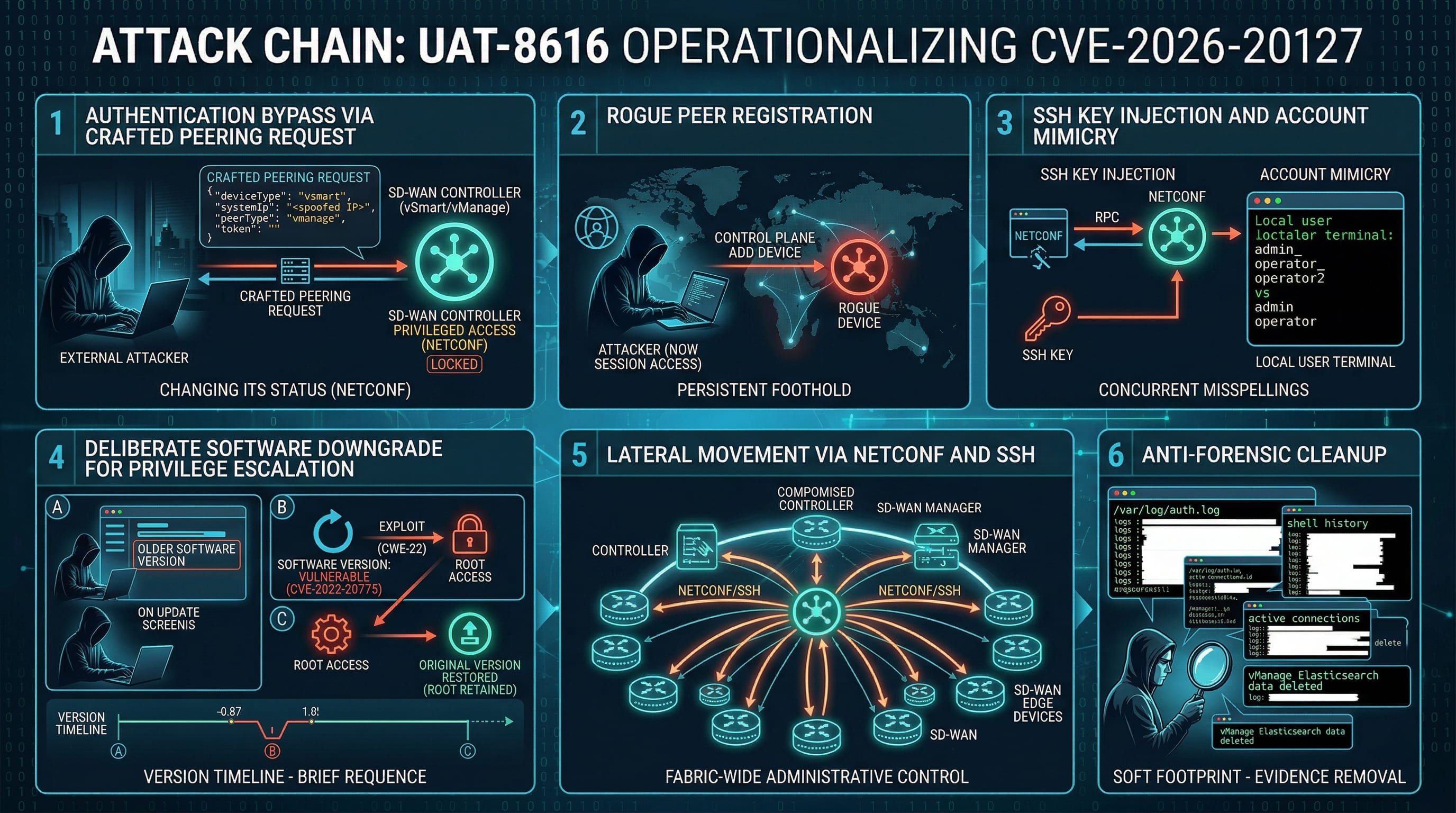
Rapid7 Labs, Cisco Talos, and ASD-ACSC collectively produced a detailed picture of how UAT-8616 operationalized this vulnerability. The attack chain demonstrates deep familiarity with Cisco SD-WAN internals and a deliberate approach to persistence, stealth, and evidence destruction.
Technical Walkthrough of CVE-2026-20127
Note: The HTTP request and NETCONF examples below are simplified representations for educational and detection-engineering purposes. They are not a working exploit and should not be interpreted as literal reproduction of UAT-8616’s tooling.
Step 1 – Crafted Peering Request (Authentication Bypass)
The peering endpoint fails to properly validate the requester’s identity. A crafted request with a spoofed systemIp and an empty or malformed token is accepted by the broken authentication code path:
POST /dataservice/device/action/authenticate HTTP/1.1
Host: <target-vmanage>:443
Content-Type: application/json

{
  "deviceType": "vsmart",
  "systemIp": "<spoofed-trusted-peer-ip>",
  "peerType": "vmanage",   // triggers the broken auth code path
  "token": ""              // empty token accepted without error
}

Expected (correct) response:   401 Unauthorized
Actual (vulnerable) response:  200 OK + session token returned
Step 2 – SSH Key Injection via NETCONF (TCP/830)
With an authenticated session established, the attacker opens a NETCONF session on TCP port 830 and issues an edit-config Remote Procedure Call (RPC) to inject a root SSH authorised key. This creates a persistent backdoor that survives password changes:
<rpc message-id="101" xmlns="urn:ietf:params:xml:ns:netconf:base:1.0">
  <edit-config>
    <target><running></running></target>
    <config>
      <system xmlns="http://cisco.com/ns/yang/Cisco-IOS-XE-native">
        <ssh-authorized-keys>
          <key>ssh-rsa AAAA[ATTACKER_PUBLIC_KEY]...</key>
        </ssh-authorized-keys>
      </system>
    </config>
  </edit-config>
</rpc>
The injected key grants permanent SSH root access that persists independently of the compromised session and remains valid even after the session token expires or credentials are rotated.
2. Detection Guidance
Given the three-year exploitation window and UAT-8616’s deliberate anti-forensic cleanup, detection requires a combination of log analysis, configuration review, and network monitoring. The following indicators cover the primary forensic artefacts left by the attack chain.
2.1 Authentication Log Review
Review /var/log/auth.log for Accepted publickey for vmanage-admin events. Any such event from an unrecognised IP address warrants investigation. Keep in mind that logs may have been deliberately cleared absence of logs for a time period is itself a suspicious indicator.
2.2 Peer List Integrity Check
Review the SD-WAN Controller’s peer list for any unrecognised or unexpected devices. UAT-8616’s attack chain relies on registering a rogue peer (Step 2) as a persistent foothold. Any device in the peer list that cannot be reconciled against authorised inventory should be treated as a potential indicator of compromise.
2.3 Local Account Audit
Review all local user accounts on SD-WAN Controllers and Managers. Look specifically for accounts whose names closely resemble but are not identical to legitimate accounts. Subtle misspellings, character substitutions, or appended numbers are common account mimicry techniques. Any account that cannot be attributed to a provisioning record should be investigated.
2.4 SSH Authorised Keys Audit
Review ~/.ssh/authorized_keys and any NETCONF-managed SSH key stores on affected devices. Any public key that cannot be attributed to an authorised administrator or system account should be removed and the system treated as compromised.
2.5 Software Version History
Review the software version history on SD-WAN appliances. A pattern of a brief downgrade to an older version followed by a return to the current version, particularly to a version vulnerable to CVE-2022-20775 is a strong indicator of Step 4 of the attack chain. This artefact may survive even where log files have been cleared.
2.6 Snort Detection Coverage
Cisco Talos has published Snort detection coverage for network-level detection of the authentication bypass attempt via the following Snort IDs: SID 65938 and SID 65958. Deploy these signatures on network inspection points with visibility to SD-WAN management interfaces.
2.7 SIEM Detections to Build
If SD-WAN telemetry is not already feeding a Security Information and Event Management (SIEM) platform, that gap should be addressed as part of the response to this advisory. The following detection rules are high-priority starting points:
- Alert on any new peer registration event in the SD-WAN control plane
- Alert on local account creation on SD-WAN Controllers or Managers
- Alert on NETCONF sessions from hosts not in an approved management host allowlist
- Alert on software version downgrade events on any SD-WAN appliance
- Alert on SSH public key additions via NETCONF
The full ASD-ACSC Cisco SD-WAN Hunt Guide (referenced below) provides additional detection logic and forensic procedures specifically developed in response to UAT-8616’s campaign.
Indicators of Compromise (IOCs)
Specific file hashes, IP addresses, and domain indicators attributed to UAT-8616 have been published by Cisco Talos in their threat intelligence report (referenced below). Rather than reproduce a point-in-time snapshot here which may become stale defenders should pull the current IOC list directly from the Talos report and ingest it into their threat intelligence platform and network defences.
Behavioural indicators that are more durable than network IOCs include the attack chain artefacts described in the Detection section above: rogue peer registrations, injected SSH keys, mimicry account names, and the downgrade-then-restore pattern in version history.
Regulatory and Industry Response
The severity of CVE-2026-20127 prompted swift regulatory action. On February 25, 2026 – the same day Cisco published the advisory, the Cybersecurity and Infrastructure Security Agency (CISA) added both CVE-2026-20127 and CVE-2022-20775 to the Known Exploited Vulnerabilities (KEV) Catalogue.
CISA also issued Emergency Directive ED 26-03, which required Federal Civilian Executive Branch (FCEB) agencies specifically to inventory all SD-WAN deployments and apply the available fixes within 24 hours. This timeline applies to federal agencies under CISA’s directive authority commercial organisations are not subject to the same mandate, though the urgency is equivalent given the exploitation history.
On March 5, 2026, two related vulnerabilities – CVE-2026-20122 and CVE-2026-20128 – were added to the KEV Catalogue, reflecting additional attack patterns identified in similar campaigns observed after the initial disclosure. Organisations should monitor Cisco’s advisory for updates covering these CVEs and assess whether their environment is exposed to the same attack surface.
Remediation: Patching and Immediate Hardening

Cisco released fixed versions of SD-WAN software addressing CVE-2026-20127. The following upgrade matrix covers affected versions:
| Affected Version | Status | Required Action | Urgency |
|---|---|---|---|
| 20.9.x | Patch available | Upgrade to 20.9.5.2 or later | Patch Now |
| 20.12.5.x | Patch available | Upgrade to 20.12.5.3 or later | Patch Now |
| 20.12.6.x | Patch available | Upgrade to 20.12.6.1 or later | Patch Now |
| 20.11, 20.13, 20.14, 20.16 | End of Life | Migrate to a supported release immediately | Migrate Immediately |
| Below 20.9 | End of Life | Migrate to a supported release immediately | Migrate Immediately |
Organisations on End of Life versions should not interpret migration as lower-priority than patching. An End of Life version has no fixed release available migration is the only path to a remediated state.
Immediate Hardening Steps While Preparing a Patch Window
- Restrict network access to management and control plane interfaces. No SD-WAN management interface should be reachable from the internet. Given that UAT-8616 was exploiting this vulnerability for years before disclosure, verify this assumption against actual firewall rules rather than relying on assumed configuration.
- Restrict NETCONF (TCP/830) to authorised management hosts only. Implement an allowlist at the network perimeter and on the device itself. Any NETCONF connection from a host not on the allowlist should be blocked and alerted.
- Run a threat hunt before declaring the environment clean. Use the ASD-ACSC Cisco SD-WAN Hunt Guide as the primary reference. Look for unexpected peering events, rogue SSH keys, unfamiliar local accounts, and evidence of the downgrade-upgrade pattern in version history.
- Apply the patch. After completing the threat hunt and confirming or ruling out compromise, apply the relevant fixed version.
Long-Term Security Improvements
CVE-2026-20127 is a case study in how the management planes of critical network infrastructure are routinely under-defended relative to application-layer systems. The following structural practices would significantly limit the blast radius of similar attacks in future.
Zero Trust for Management Planes
SD-WAN orchestration platforms should only be reachable from dedicated, audited management networks protected by Multi-Factor Authentication (MFA)-gated jump hosts. When NETCONF and management APIs are not exposed even to internal flat networks, the attack surface for an adversary who achieves internal network access shrinks substantially. Zero Trust network access (ZTNA) controls should apply to management plane access with the same rigour applied to internet-facing applications.
Control-Plane Event Monitoring
Unexpected peering events should trigger real-time alerts, not merely appear in logs. Integrate SD-WAN telemetry into a Security Information and Event Management (SIEM) platform. If detection rules for new peer registration and local account creation do not exist in your environment, build them now. The absence of these detections is why UAT-8616 operated undetected for three years in affected environments.
Patch Velocity on Network Infrastructure
Firmware and software currency on control-plane components requires the same urgency applied to internet-facing services. These systems are high-value targets. Three years of undetected exploitation happened partly because the gap between vulnerability introduction and patch availability was enormous but even after a patch exists, slow deployment windows create prolonged exposure. Establish a patch SLA for network infrastructure that is measured in days, not quarters.
Closing Assessment
Any organisation running affected Cisco Catalyst SD-WAN software should patch immediately, restrict management plane access now, and run a threat hunt before declaring the environment clean. The three-year exploitation window means patching is necessary but not sufficient on its own.
The relevant question is not only “Are we vulnerable?” it is “Were we already compromised?” The tradecraft UAT-8616 employed clean logs, mimicry account names, and a software version reset after privilege escalation is deliberate and effective. Absence of obvious indicators is not evidence of a clean environment. A structured threat hunt using the ASD-ACSC guide is the only basis for a defensible answer.
Connect with QuassrCyberTech Experts
Ready to strengthen your organization's security posture?
At QuassrCyberTech, our specialized cybersecurity solutions help organizations stay ahead of evolving risks. From Vulnerability Assessment and Penetration Testing (VAPT) to Security Operations Center (SOC) implementation, Red Team exercises, and Governance, Risk, and Compliance (GRC) frameworks, we provide the expertise and tools needed to secure your digital assets and infrastructure.
Contact us today to develop a customized security strategy for your organization.
References:
Cisco Security Advisory – cisco-sa-sdwan-rpa-EHchtZk
NVD – CVE-2026-20127 Detail
Cisco Talos – Active exploitation of Cisco Catalyst SD-WAN by UAT-8616
Rapid7 Labs – Critical Cisco Catalyst Vulnerability Exploited in the Wild (CVE-2026-20127)
CISA – Emergency Directive ED 26-03
CISA KEV Catalogue – CVE-2022-20775 and CVE-2026-20127 Added
ASD-ACSC – Cisco SD-WAN Hunt Guide (PDF)
Arctic Wolf – CVE-2026-20127: Cisco Catalyst SD-WAN Controller Authentication Bypass
Tenable – CVE-2026-20127: Cisco Catalyst SD-WAN Zero-Day Authentication Bypass
The Hacker News – Cisco SD-WAN Zero-Day CVE-2026-20127 Exploited Since 2023
Help Net Security – Threat actor leveraged Cisco SD-WAN zero-day since 2023
SOCRadar – CVE-2026-20127: Cisco Catalyst SD-WAN Auth Bypass Exploited
Censys – February 27 Advisory: Cisco Catalyst SD-WAN Controller and Manager Authentication Bypass</spoofed-trusted-peer-ip></target-vmanage>