
Introduction
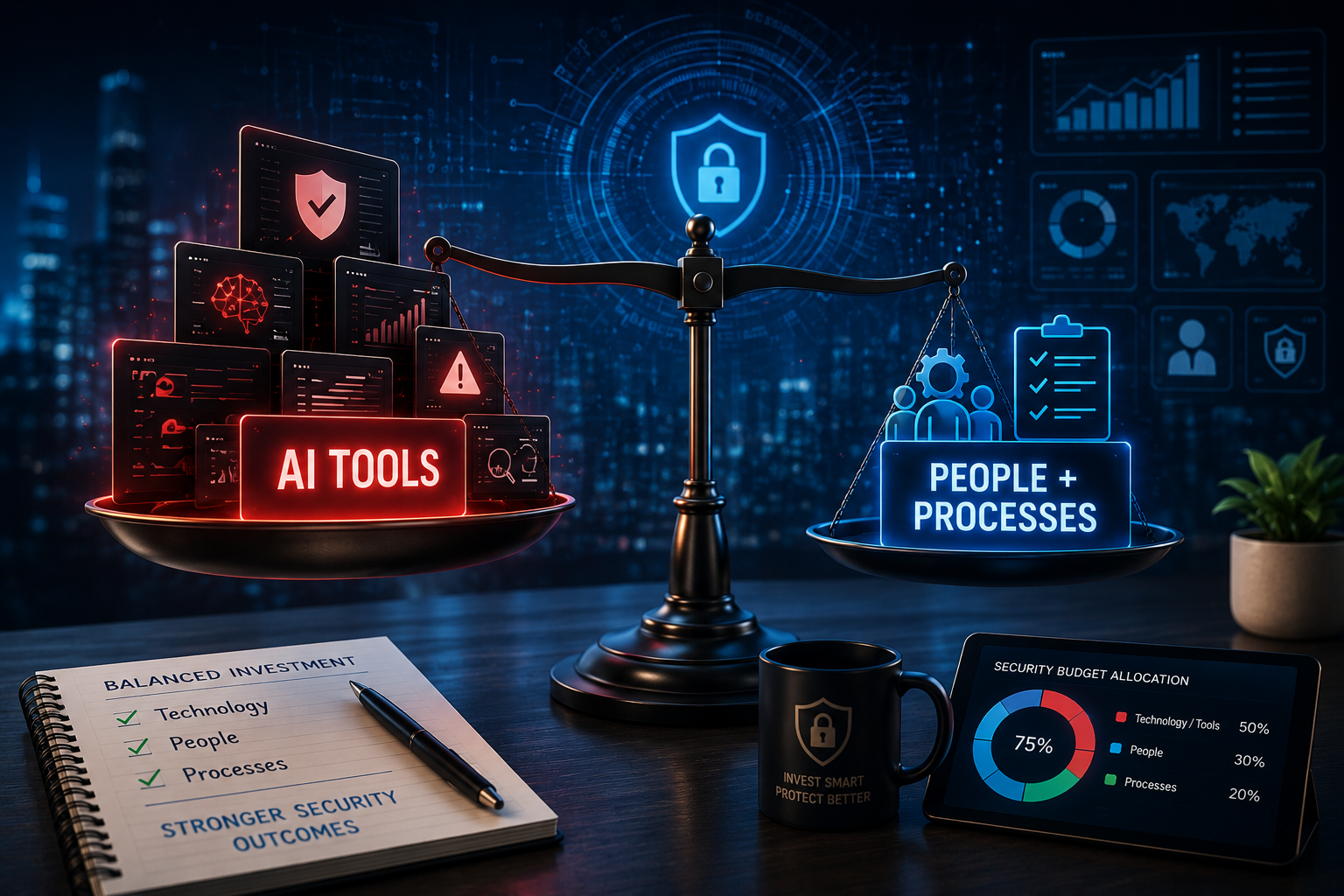
Artificial intelligence has become one of the most significant forces shaping modern cybersecurity. Organizations are investing heavily in AI powered security platforms that promise faster threat detection, automated incident response, and improved operational efficiency. While these technologies offer substantial benefits, many companies are unknowingly creating an imbalance in their cybersecurity programs by prioritizing tools over people and processes.
As cybersecurity budgets continue to grow, security leaders are facing an important question: are organizations investing in the right controls, or are they simply purchasing more technology? The answer often reveals a common challenge overspending on security tools while underinvesting in the talent and operational frameworks needed to make those tools effective.
The Growing Appeal of AI Powered Security Solutions
The cybersecurity market is flooded with AI driven solutions that promise to transform security operations. From threat detection and behavior analytics to automated response capabilities, vendors are positioning artificial intelligence as the answer to increasingly sophisticated cyber threats.
Organizations are attracted to these solutions because they can process enormous amounts of data far faster than human analysts. AI can identify suspicious patterns, prioritize alerts, and assist security teams in managing complex environments. As a result, many organizations allocate a significant portion of their security budgets toward acquiring the latest technologies.
However, technology alone cannot guarantee stronger security outcomes. Without the proper expertise and operational maturity, even the most advanced platforms can fail to deliver their intended value.
When More Tools Create More Problems
Many organizations assume that adding new security tools automatically improves protection. In reality, excessive technology investments often lead to tool sprawl, where multiple solutions perform similar functions while generating overlapping alerts and data.
Security teams frequently find themselves managing dozens of disconnected platforms. Instead of improving visibility, this complexity can create confusion and operational inefficiencies. Analysts spend valuable time switching between systems, investigating duplicate alerts, and maintaining integrations.
In many cases, organizations use only a fraction of the capabilities available within their existing security stack. Advanced AI features remain underutilized because teams lack the time, training, or resources necessary to operationalize them effectively.
The Critical Role of Cybersecurity Talent
Despite rapid advances in automation, people remain the most important component of any cybersecurity program. Skilled professionals provide the judgment, experience, and contextual understanding that technology cannot replicate.
Security analysts investigate incidents, validate threats, perform threat hunting activities, and make critical decisions during security events. Without qualified personnel, organizations struggle to maximize the value of their technology investments.
Unfortunately, many companies allocate substantial budgets toward tools while delaying investments in hiring, training, and retaining cybersecurity professionals. This imbalance often leads to analyst burnout, alert fatigue, and slower response times.
Organizations that prioritize workforce development typically achieve stronger security outcomes because their teams are better equipped to leverage available technologies and adapt to evolving threats.
Why Processes Matter Just as Much as Technology
Cybersecurity success depends not only on tools and talent but also on well defined processes. Effective security operations require clear procedures for incident response, vulnerability management, risk assessment, and governance.
Many organizations discover process gaps only after experiencing a security incident. Response teams may lack documented procedures, escalation paths, or communication frameworks, leading to delays and confusion during critical situations.
Mature processes create consistency and accountability. They help organizations respond faster, recover more efficiently, and reduce the likelihood of repeated security failures.
Investments in process maturity often deliver long term benefits that extend beyond individual technologies and improve overall organizational resilience.
Measuring Security Effectiveness Beyond Technology Purchases
One of the most common budgeting mistakes is evaluating cybersecurity maturity based on the number of tools deployed. Security leaders should focus on measurable outcomes rather than product counts.
Metrics such as mean time to detect threats, mean time to respond, vulnerability remediation speed, and incident recovery performance provide more meaningful insights into security effectiveness.
By focusing on outcomes, organizations can identify where investments generate the greatest impact. Sometimes hiring an additional analyst or improving security awareness training can reduce risk more effectively than purchasing another AI powered platform.
Building a Balanced Cybersecurity Budget
The most effective cybersecurity programs balance investments across three key areas: technology, people, and processes.
Technology provides visibility and automation. People provide expertise and decision-making. Processes provide structure and consistency. When these three elements work together, organizations create a security program that is both resilient and adaptable.
Security leaders should regularly evaluate whether new technology investments address genuine operational challenges or simply add complexity to existing environments. Budget decisions should align with business objectives, risk priorities, and operational needs rather than industry trends alone.
The Future of Cybersecurity Spending
Artificial intelligence will continue to play a major role in cybersecurity innovation. AI powered solutions are helping organizations manage growing attack surfaces and respond to threats more efficiently than ever before.
However, successful organizations will view AI as an enhancement rather than a replacement for human expertise. The strongest security programs will combine intelligent automation with skilled professionals and mature operational processes.
The future of cybersecurity is not about having the most tools. It is about creating a balanced ecosystem where technology, talent, and processes work together to deliver meaningful security outcomes.
Conclusion
As organizations expand their cybersecurity budgets, it is essential to look beyond the latest AI powered technologies. While advanced security tools can improve detection and response capabilities, they cannot replace experienced professionals or effective operational processes.
Companies that focus exclusively on technology often overlook the foundations of a successful security program. By investing strategically across people, processes, and technology, organizations can build stronger defenses, improve resilience, and maximize the value of every cybersecurity investment.
In the age of AI, the organizations that succeed will not necessarily be the ones spending the most money on tools. They will be the ones investing in the right controls and ensuring those controls work together effectively.
Connect with QuassrCyberTech Experts
Ready to strengthen your organization's security posture?
At QuassrCyberTech, our specialized cybersecurity solutions help organizations stay ahead of evolving risks. From Vulnerability Assessment and Penetration Testing (VAPT) to Security Operations Center (SOC) implementation, Red Team exercises, and Governance, Risk, and Compliance (GRC) frameworks, we provide the expertise and tools needed to secure your digital assets and infrastructure.
Contact us today to develop a customized security strategy for your organization.