
Introduction
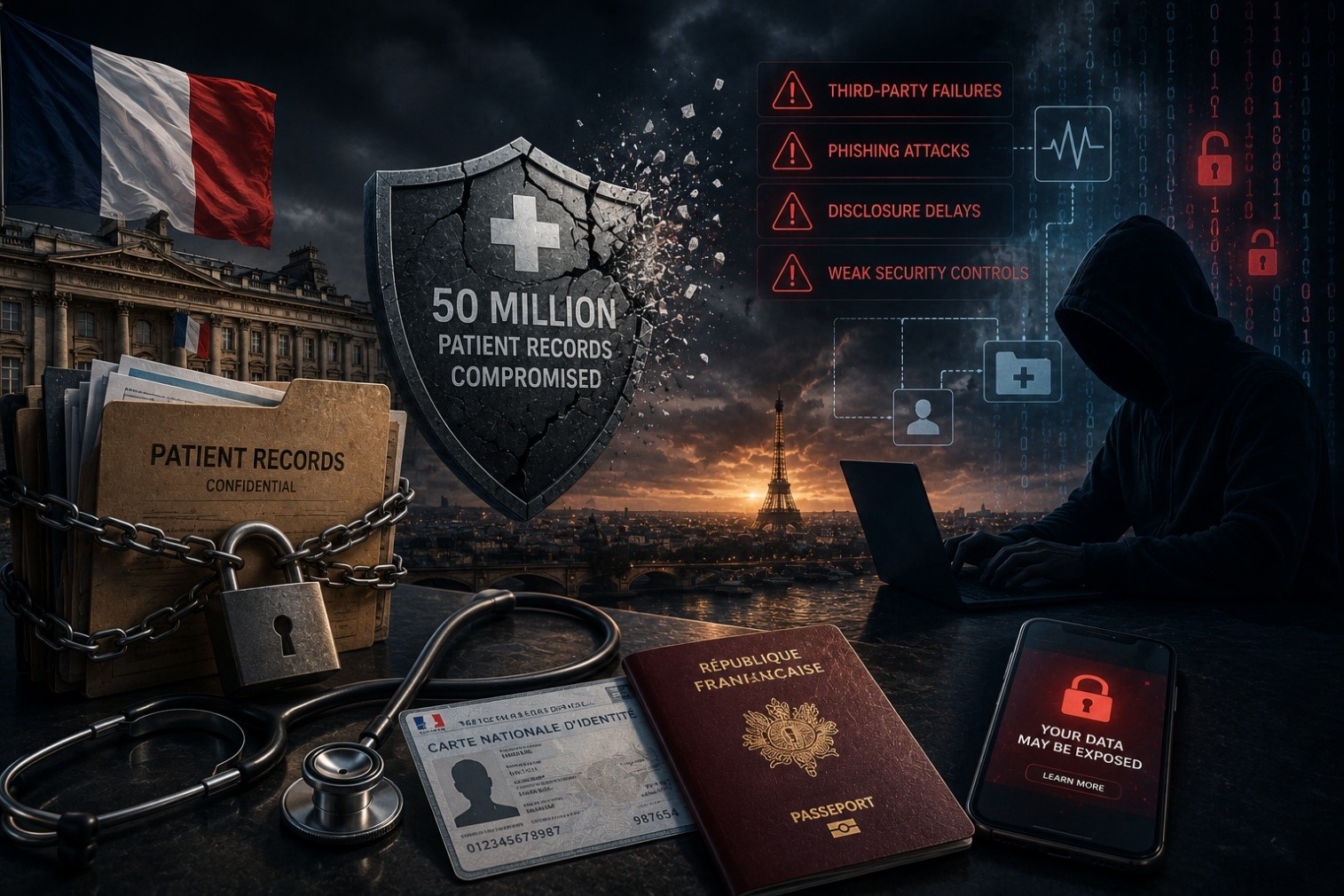
In February 2026, France found itself facing a healthcare data breach that security experts had been warning about for years. Hackers stole 15.8 million patient records from a medical software provider, exposing sensitive information that included clinical notes, mental health diagnoses, and confidential observations recorded by doctors. Much of this data later appeared on dark web marketplaces.
The incident was not an isolated case. In January 2024, healthcare payment processors Viamedis and Almerys suffered breaches within days of each other, exposing the health insurance data of 33 million people. Together, these incidents affected nearly 50 million individuals in a country of 68 million.
The problem was never a lack of regulation. France has some of the strongest data protection laws in Europe. The real issue was a failure to address long-standing security weaknesses before they turned into national-scale breaches. This piece examines how these incidents happened, why they continue to occur, and whether the measures now being introduced will be enough to protect patient data in the future.
Three Breaches That Built a Crisis
Viamedis and Almerys (2024)
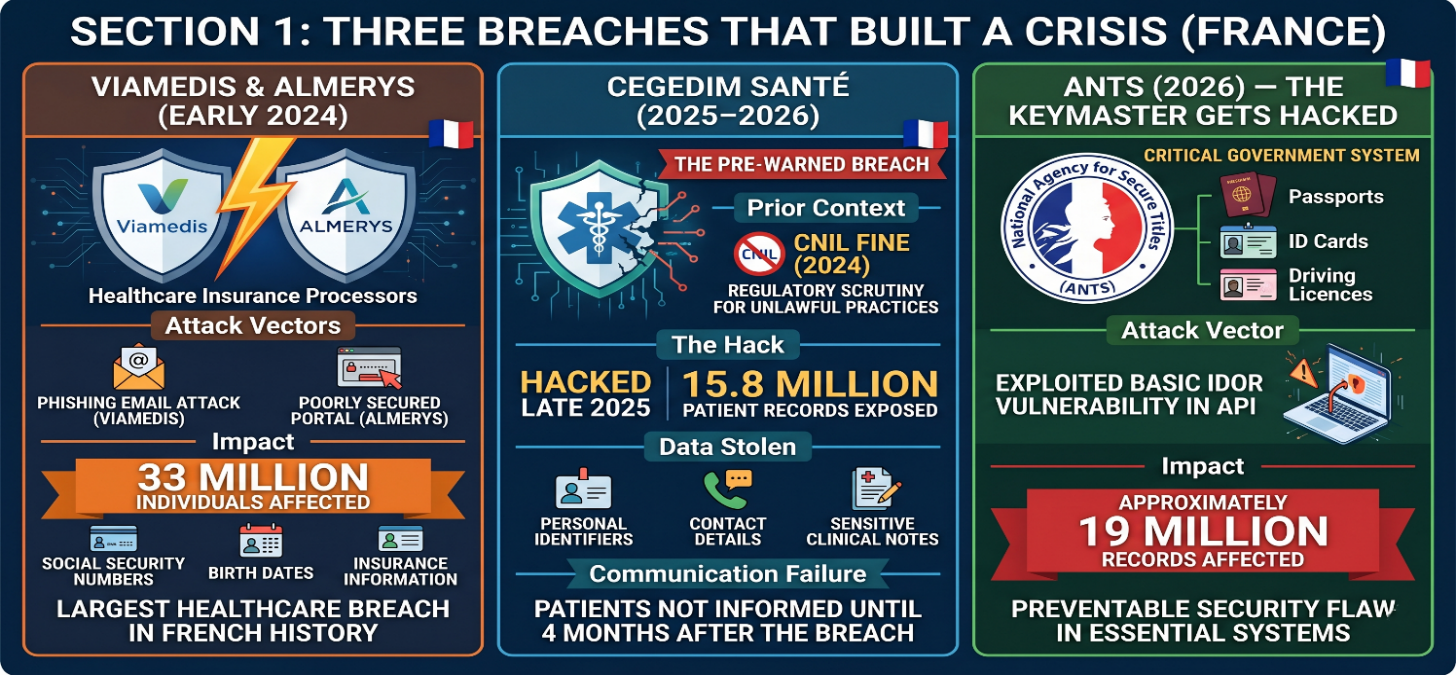
Most French citizens had never heard of Viamedis or Almerys, yet both processed insurance transactions for millions. Attackers compromised Viamedis via a spear-phishing campaign targeting employee credentials, then pivoted laterally through the network due to absent network segmentation. Almerys fell days later through an insufficiently secured web portal lacking rate-limiting, brute-force protection, or mandatory multi-factor authentication (MFA). Together, 33 million records were exposed in the largest coordinated healthcare breach in French history.
Cegedim Santé (2025–2026)
Cegedim Santé had already attracted CNIL scrutiny before suffering a major intrusion in late 2025. Attackers exfiltrated 15.8 million patient records - including clinical notes stored in plaintext or weakly encrypted formats - by exploiting unpatched vulnerabilities in their Electronic Health Record (EHR) software stack and over-privileged service accounts. Patients were not notified for several months, violating the GDPR Article 33 requirement for breach notification within 72 hours.
ANTS Identity Agency (2026)
In April 2026, France's National Agency for Secure Titles (ANTS) - the organization responsible for passports, national ID cards, and driving licences - suffered a breach affecting approximately 19 million records. The attackers exploited a basic IDOR (Insecure Direct Object Reference) vulnerability in the agency's API, demonstrating that even critical government systems remained vulnerable to well-known and preventable security flaws.
Four Structural Failures Behind the Pattern
Although the incidents involved different organizations, they exposed many of the same weaknesses.
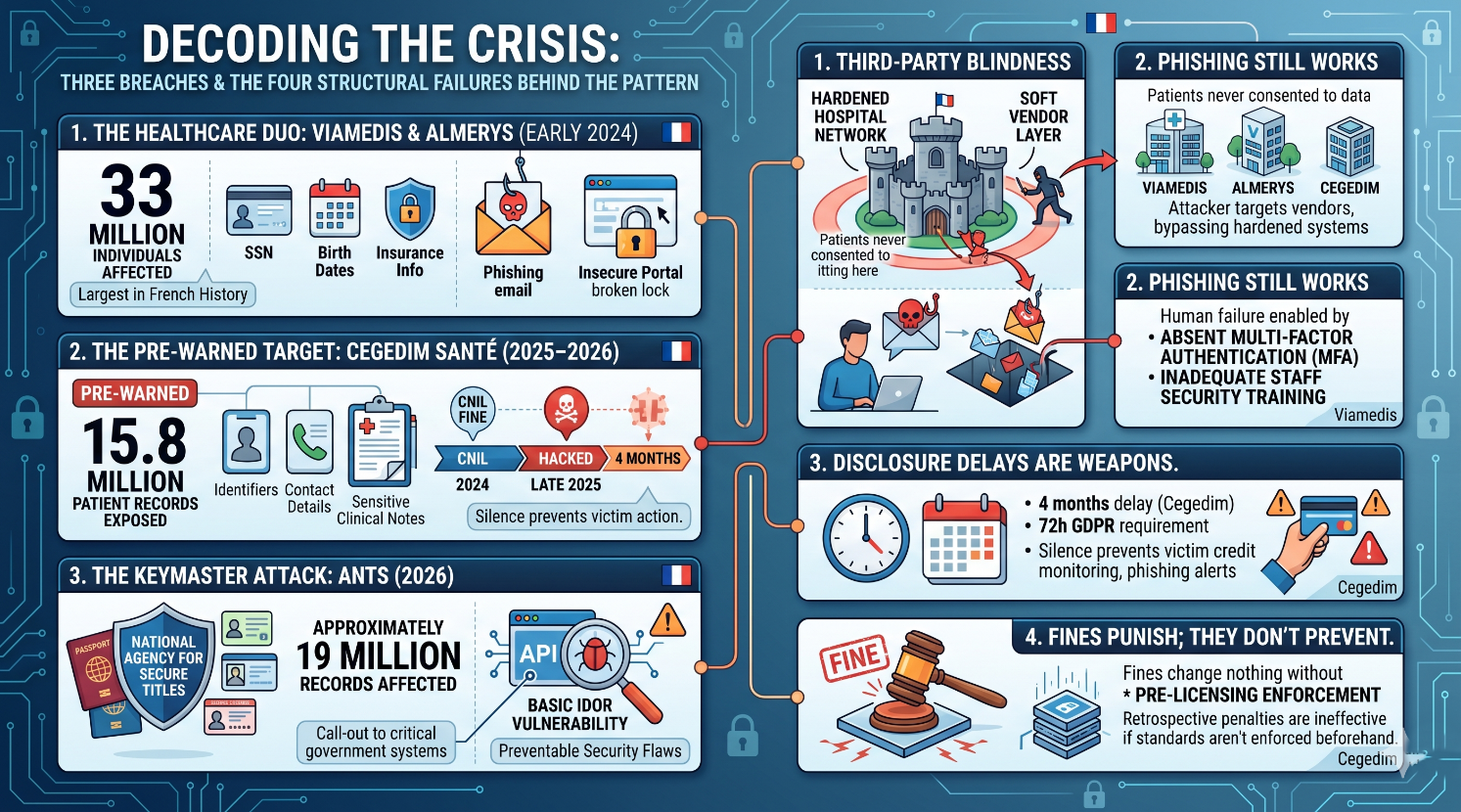
Overreliance on third parties: Viamedis, Almerys, and Cegedim processed health data at scale without equivalent security oversight. Under GDPR Article 28, controllers must enforce security requirements on processors contractually - a requirement not met here. The absence of AES-256 encryption-at-rest, strict access controls, and regular penetration testing turned these vendors into high-value, low-resistance targets.
Human error and weak access controls: Phishing was the entry point in multiple incidents. Without MFA - whether TOTP (RFC 6238) or FIDO2/WebAuthn - a single stolen password unlocked millions of records. Over-permissioned accounts then allowed privilege escalation, violating basic least-privilege principles.
Delayed breach disclosure: GDPR Article 33 requires supervisory authority notification within 72 hours. Cegedim failed this threshold by months, denying affected individuals time to freeze credit, rotate credentials, and guard against identity fraud.
Reactive rather than preventive security: Fines followed breaches; they didn't prevent them. Effective security demands proactive controls - continuous vulnerability scanning, SIEM-based anomaly detection, and annual penetration tests aligned with ANSSI's EBIOS Risk Manager or ISO 27001.
What France Is Doing - And What It Is Missing
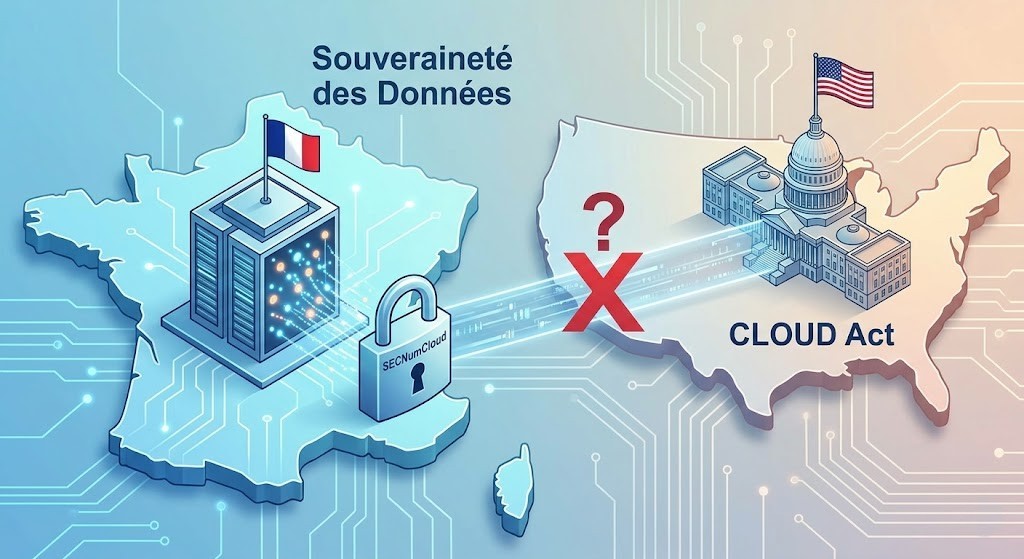
In 2026, France began migrating its Health Data Hub (HDH) from Microsoft Azure to Scaleway, a French provider certified under ANSSI's SecNumCloud framework. SecNumCloud enforces requirements including data residency within French jurisdiction, access controls limiting foreign legal reach, and security audits aligned with European standards. The migration addresses sovereignty concerns arising from the U.S. CLOUD Act, under which American authorities could compel data access regardless of storage location.
However, cloud sovereignty addresses jurisdictional risk, not attack-surface risk. Moving data to a sovereign cloud does not patch unprotected APIs, enforce MFA, or stop phishing. Healthcare organisations continue to face ransomware via malicious attachments, Remote Desktop Protocol (RDP) brute-force attacks, and supply-chain compromises. Several French hospitals have suffered operational shutdowns requiring emergency patient diversions.
What remains absent is a sector-wide mandate for technical baselines: AES-256 encryption for all records at rest, TLS 1.2 minimum in transit, mandatory MFA across all clinical system access, zero-trust network architecture limiting lateral movement, and automated breach detection with defined SLAs.
Conclusion: Sovereignty Without Security Is Still Vulnerable
By mid-2026, researchers identified a large aggregated dataset combining records from multiple French breaches - healthcare, financial, and identity data for tens of millions. Such datasets enable highly targeted attacks: synthesised identities for insurance fraud, personalised phishing using clinical history, and extortion leveraging mental health or prescription records.
Closing these gaps requires binding technical standards for all healthcare vendors: mandatory MFA, AES-256 encryption at rest, authenticated and rate-limited APIs, annual third-party penetration testing, and SIEM-based monitoring with defined incident response playbooks. Breach notification timelines must be enforced, not treated as aspirational.
France has strengthened privacy regulation, increased oversight, and taken meaningful steps toward data sovereignty. Yet recent breaches demonstrate that compliance without enforceable technical controls is insufficient. Protecting health data is not solely a legal obligation - it is a patient safety issue. The question is no longer whether the next breach will occur, but whether France will have built the technical resilience to contain it when it does.
Connect with QuassrCyberTech Experts
Ready to strengthen your organization's security posture?
At QuassrCyberTech, our specialized cybersecurity solutions help organizations stay ahead of evolving risks. From Vulnerability Assessment and Penetration Testing (VAPT) to Security Operations Center (SOC) implementation, Red Team exercises, and Governance, Risk, and Compliance (GRC) frameworks, we provide the expertise and tools needed to secure your digital assets and infrastructure.
Contact us today to develop a customized security strategy for your organization.
References
- CNIL - Viamedis and Almerys data breach: CNIL launches investigation (February 2024)
- CNIL - Data breach: FRANCE TRAVAIL fined €5 million (January 2026)
- France24 / The Local - Hackers steal medical details of 15 million in France (February 2026)
- BleepingComputer - Data breaches at Viamedis and Almerys impact 33 million in France (February 2024)
- The Register - France's 'Secure' ID agency probes breach as crooks claim 19M records (April 2026)