
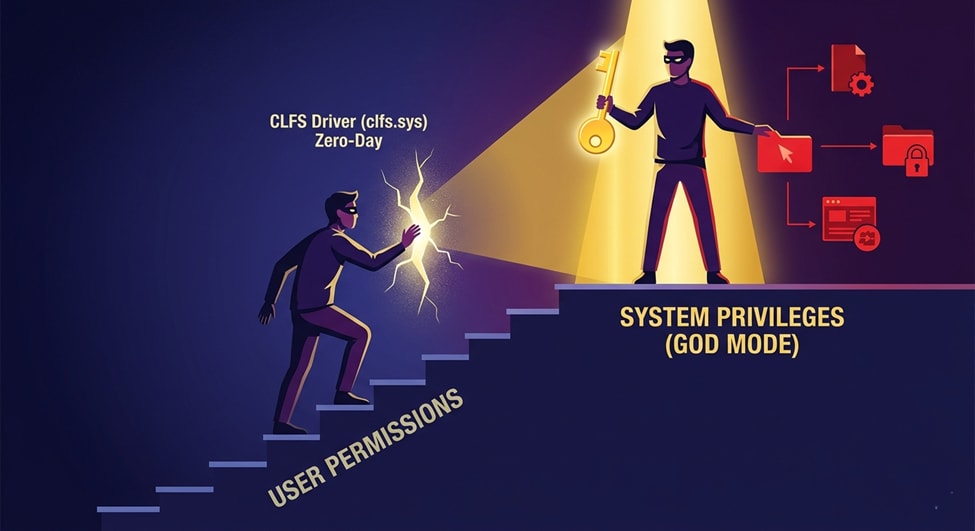
For years, ransomware operators relied on flashy, high impact Remote Code Execution (RCE) flaws to breach perimeters. However, as perimeter defenses have hardened, the strategy has shifted toward a "low and slow" approach. Enter the Common Log File System (CLFS), a relatively obscure Windows driver that has become one of the most exploited components in modern cybersecurity history.
In 2025 and early 2026, a series of zero day vulnerabilities in the CLFS driver (such as CVE-2025-29824) were weaponized by sophisticated threat actors like Storm 2460 and the Nokoyawa ransomware group. These attacks don't just lock files; they exploit the very fabric of the Windows kernel to gain "God Mode" (SYSTEM privileges), rendering traditional security boundaries obsolete. This blog explores why CLFS is a recurring nightmare for IT departments and how organizations can defend against this specific class of kernel-level threats.
1. The Role of CLFS in Windows
The Common Log File System (CLFS) is a high performance, general purpose logging subsystem built into the Windows kernel since Windows Vista. It is not an end user application it operates silently in the background, providing transactional logging services to applications and system processes that need fast, reliable, and recoverable write operations.
CLFS is used by critical Windows components including Active Directory, SQL Server, and various kernel mode drivers. Because it runs in kernel space with SYSTEM level privileges, any vulnerability in CLFS is inherently severe a successful exploit does not merely affect a user application, it compromises the entire operating system.
2. Anatomy of an Exploit: Why CLFS?
The Common Log File System (clfs.sys) is a kernel-mode driver introduced in Windows Server 2003 that provides a high performance logging framework for applications. Because it operates within the kernel, any vulnerability here allows an attacker to jump from a restricted user account to full administrative control.
The Mechanism of Failure:
Most CLFS vulnerabilities, including the recent 2025 outbreaks, stem from how the driver parses Base Log Files (.blf). These files contain complex metadata structures that define how logs are stored and accessed. Attackers craft "malformed" .blf files that include invalid offsets or size fields.
When the driver attempts to process these malicious files, it triggers a Use After Free (UAF) or a Heap Buffer Overflow.
By corrupting kernel memory, an attacker can overwrite the security token of their own process. Once the token is replaced with a SYSTEM-level token, the attacker is no longer a guest; they are the owner of the machine.
Recent Statistics and Trends
- Volume: According to CISA’s Known Exploited Vulnerabilities (KEV) catalog, CLFS-related flaws have accounted for a significant percentage of all Windows privilege escalation zero days since 2022.
- Success Rate: Because CLFS exploits are often "low complexity" and do not require user interaction beyond executing a file, they have a high success rate in automated ransomware playbooks.
3. Real World Impact: The Play Ransomware & Storm-2460
The theoretical danger of a zero day becomes a reality when combined with ransomware. In mid 2025, the threat group Storm 2460 began utilizing CVE 2025-29824 as a critical link in their attack chain.
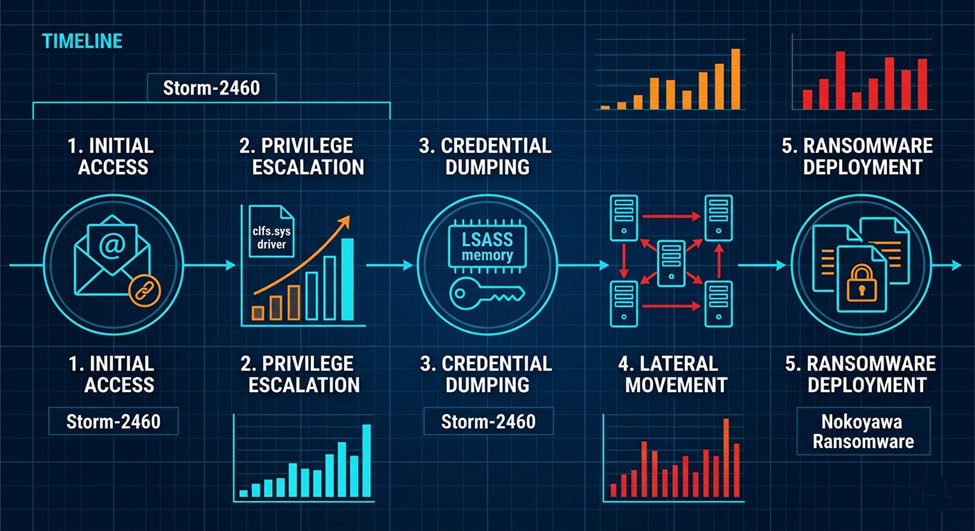
The Attack Chain
- Initial Access: Using trojanized software (e.g., fake AI productivity tools) to gain a foothold as a standard user.
- Privilege Escalation (The CLFS Hit): The malware executes the CLFS exploit to instantly gain SYSTEM privileges.
- Credential Dumping: With elevated rights, the attackers dump the LSASS memory or the SAM database to harvest administrative passwords.
- Lateral Movement: They use the harvested credentials to move across the network.
- Exfiltration and Encryption: Finally, the Play or Nokoyawa ransomware is deployed to exfiltrate data and encrypt the environment.
The speed of this transition is staggering. In documented cases, attackers moved from initial entry to full domain compromise in less than four hours by bypassing the "wait time" usually associated with manual privilege escalation.
4. Beyond Patching: Defense-in-Depth Strategies
While Microsoft consistently releases patches during "Patch Tuesday," the recurring nature of CLFS flaws suggests that patching alone is a reactive game. Organizations must adopt a proactive, multi layered defense.
Technical Mitigations
- EDR/XDR Monitoring: Configure Endpoint Detection and Response tools to alert on any process creating or modifying .blf files in unusual directories (e.g., C:\Users\Public\).
- LSASS Protection: Enable Windows Defender Credential Guard. Even if an attacker gains SYSTEM privileges via CLFS, Credential Guard uses virtualization based security to prevent them from stealing clear text passwords.
- Attack Surface Reduction (ASR): Implement ASR rules to block the execution of potentially obfuscated scripts and suspicious executables that often serve as the "delivery vehicle" for the kernel exploit.
The Role of HMAC Verification
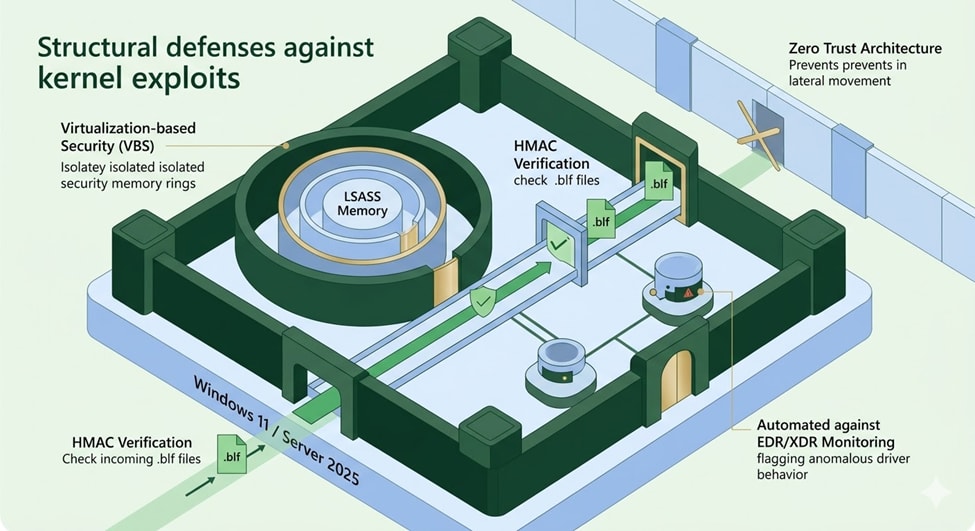
Microsoft has recently tested a new mitigation in Windows 11 and Server 2025 that appends Hash based Message Authentication Codes (HMAC) to CLFS log files. This ensures that the driver can verify if a .blf file has been tampered with before attempting to parse it.
| Feature | Impact on Attackers |
|---|---|
| Kernel Patching | Fixes specific known flaws (CVEs). |
| HMAC Verification | Addresses the class of file tampering vulnerabilities. |
| Privilege Isolation | Limits the damage an elevated process can do. |
5. Conclusion: Breaking the Cycle
The persistent exploitation of CLFS zero days highlights a critical truth in cybersecurity: attackers don't break in; they climb up. By turning a standard user into a system administrator in seconds, ransomware gangs have found a reliable "escalator" that bypasses many modern defenses.
As we move through 2026, the focus must shift from simply "chasing CVEs" to implementing structural defenses like Virtualization-based Security (VBS) and Zero Trust architectures. The goal is to ensure that even if an attacker finds the next "hidden gate" in the Windows kernel, they find themselves locked in a room with nowhere else to go.
What is your organization’s current mean time to patch (MTTP) for critical kernel vulnerabilities?
Connect with QuassrCyberTech Experts
Ready to strengthen your organization's security posture?
At QuassrCyberTech, our specialized cybersecurity solutions help organizations stay ahead of evolving risks. From Vulnerability Assessment and Penetration Testing (VAPT) to Security Operations Center (SOC) implementation, Red Team exercises, and Governance, Risk, and Compliance (GRC) frameworks, we provide the expertise and tools needed to secure your digital assets and infrastructure.
Contact us today to develop a customized security strategy for your organization.
Further Reading & References
- Microsoft Security: Exploitation of CLFS Zero-Day Leads to Ransomware Activity
- CISA KEV Catalog: Official list of actively exploited vulnerabilities
- Microsoft Security Response Center (MSRC): Analysis of CVE-2025-29824
- NIST CSF 2.0: Framework for managing infrastructure risk
- Kaspersky GReAT Report: Deep dive into Nokoyawa Ransomware and CLFS