
Digital twins, real-time virtual replicas of physical systems are changing the way organizations design, operate and maintain critical infrastructure. From smart power grids and factory floors to hospital networks and urban transport, the technology unlocks remarkable efficiency gains. But the very thing that makes digital twins so powerful – a live, data-rich mirror of high-value physical assets is exactly what makes them such an attractive target for adversaries.
This article looks at the evolving threat landscape, walks through real-world incidents and the lessons they left behind, offers a practical step-by-step threat assessment guide and lays out the defense strategies organizations need to start acting on today.
1. The Digital Twin Revolution and Its Shadow Side
Digital twin technology was first conceptualized by Michael Grieves at the University of Michigan in the early 2000s and has since grown far beyond its industrial origins. Today these virtual models span healthcare monitoring, smart-city planning, financial payment infrastructure, aerospace maintenance and military simulation.
Market Scale: Gartner projects the simulation digital twin market will grow from $35 billion in 2024 to $379 billion by 2034. Mordor Intelligence forecasts the broader market reaching nearly $131 billion by 2029. 70% of C-suite technology executives at large enterprises are already exploring or investing in digital twins.
That explosive adoption, however, is moving faster than the security frameworks designed to protect these systems can keep up. A digital twin needs to continuously pull in sensitive real-world data to stay accurate – and every data feed, API endpoint, IoT sensor connection and cloud integration is both a capability and a potential entry point for attackers.
1.1 What Is Digital Twin Hacking?
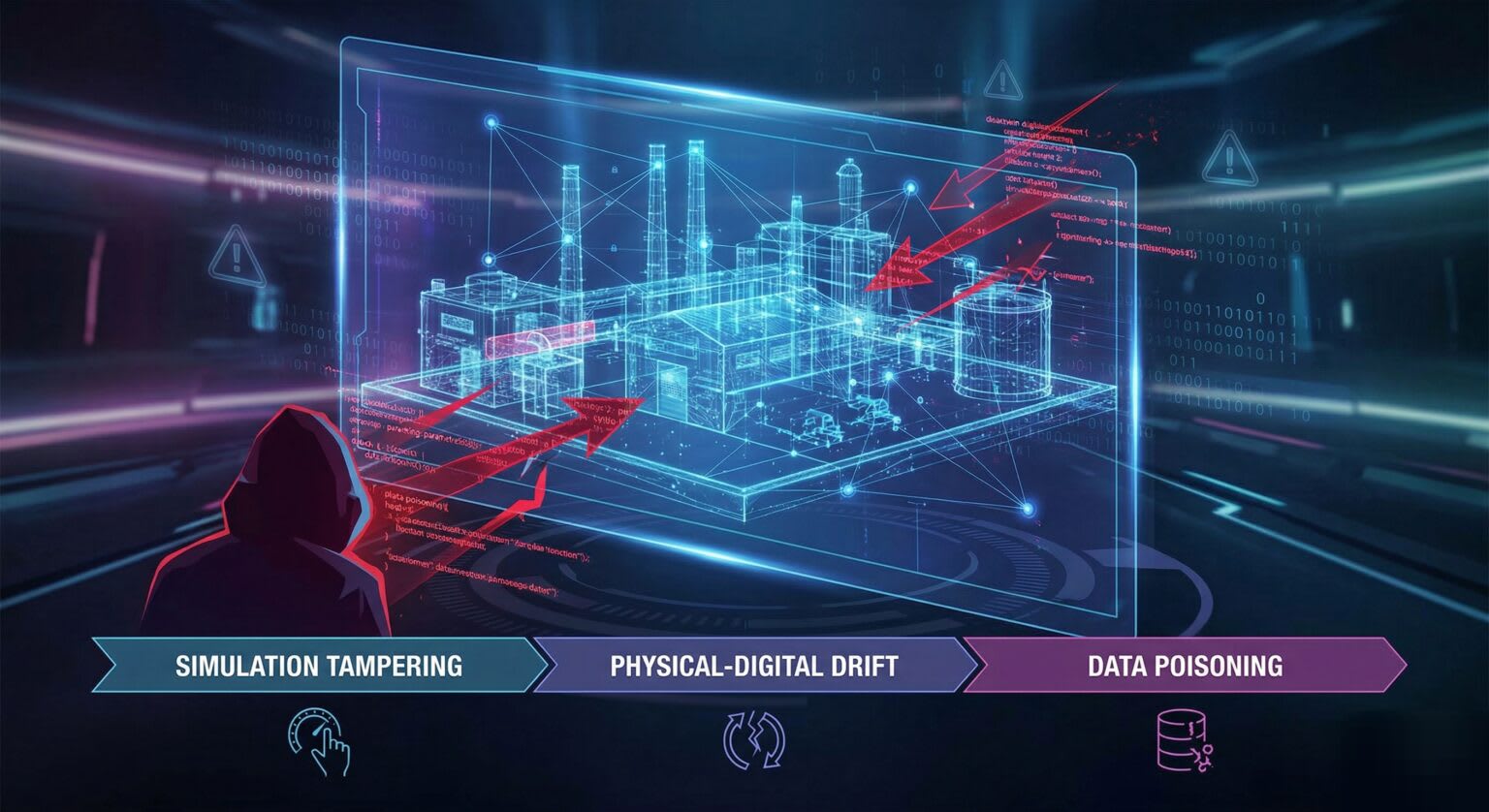
Digital twin hacking refers to any unauthorized interaction with or manipulation of a virtual replica in ways that degrade its accuracy, leak its data or pivot the attack onto the underlying physical system. Unlike conventional IT breaches that target data at rest, digital twin attacks can produce direct, real-time physical consequences.
1.2 The ‘Evil Digital Twin’
UMGC cybersecurity faculty coined the concept of the ‘evil digital twin’ – a malicious virtual software model built by an attacker to mimic a target organization’s environment. Once established, it can be weaponized for ransomware, highly targeted cyber warfare and advanced phishing with a level of specificity that traditional attack methods cannot achieve.
1.3 Data Poisoning
Adversaries who tamper with sensor outputs or training data can silently corrupt the twin’s model, causing it to generate flawed operational guidance incorrect treatment recommendations in healthcare, or masked faults in a power grid.
1.4 Unauthorized Access and IoT Vulnerabilities
Weak access controls and insecure IoT integration points particularly at IT/OT boundaries create pathways for lateral movement. A compromise at any node in the chain can cascade into the twin and from there into the physical system it represents.
The Scale of the Problem: By the Numbers
IBM Cost of Data Breach 2025: 86% of organizations experienced significant operational disruptions due to security breaches. The global average breach lifecycle reached a record low of 241 days. Organizations using security AI and automation extensively reduced their breach lifecycle by 80 days and saved nearly $1.9 million in costs compared to those not using these tools.
A breach that might once have been contained within an IT network can now propagate through the digital twin and manifest in physical operational failures in real time. IEEE Access (2025) categorizes digital twin risk by tier from component-level (medium-high risk) through to network-level twins (extreme risk) where attackers gain full topology visibility enabling lateral movement, traffic interception and large-scale service disruption.
Real-World Case Studies: What Actually Happened
Theory only goes so far. The following incidents illustrate what happens when digital or cyber-physical systems are successfully compromised and what organizations learned as a result. Each case has direct implications for how digital twins must be secured today.
Case Study: European Bank: APT Attack on Payment Infrastructure Twin (2023–2024)
Sector: Financial Services
A major European financial institution deployed a comprehensive digital twin of its payment processing infrastructure following a series of disruptions linked to Advanced Persistent Threat (APT) groups targeting high-value transaction systems. The bank had discovered that attackers had been conducting extended reconnaissance of its transaction routing architecture mapping data flows, identifying peak processing windows and probing authentication handshakes.
By creating a digital twin of the payment infrastructure and deploying it as a ‘honeypot-adjacent’ environment an instrumented replica that appeared to attackers as a live system the bank’s security team was able to observe attacker behavior in controlled conditions. Adversarial tactics, techniques and procedures (TTPs) observed in the twin environment were used to harden the production system before attackers could execute against it.
Without this proactive twinning strategy, analysts estimated the attack could have resulted in billions in direct transaction fraud losses and severe reputational damage. The digital twin served as both an early-warning system and an intelligence-gathering platform.
Relevance to Digital Twins: This case illustrates the double-edged nature of digital twin technology in financial services: the same twin that enables proactive defense can, if compromised, hand adversaries a detailed blueprint of the institution’s most sensitive operational infrastructure.
Key Lessons Learned
- Digital twins can be actively weaponized for defense not just used as passive replicas.
- A twin used as a honeypot must be carefully isolated so that attacker activity within it cannot pivot to production systems.
- The intelligence gathered from twin-based adversary observation is only valuable if acted upon rapidly threat intelligence cycles must be tightly integrated with security operations.
- Regulatory compliance requirements (e.g., PCI-DSS, DORA in Europe) must extend to digital twin environments managing financial data.
Action for Digital Twin Operators: For financial institutions, isolate digital twin environments with strict egress controls. Any twin that processes or mirrors transaction data must be treated as in-scope for PCI-DSS and equivalent regulatory frameworks with full audit logging and regular penetration testing.
Sector-Specific Consequences: Financial Services
Beyond the European bank case, financial sector digital twins managing payment infrastructure, fraud detection models and liquidity simulations represent high-value intelligence targets. Compromise enables adversaries to time attacks with precision against identified peak windows or exploit known authentication patterns.
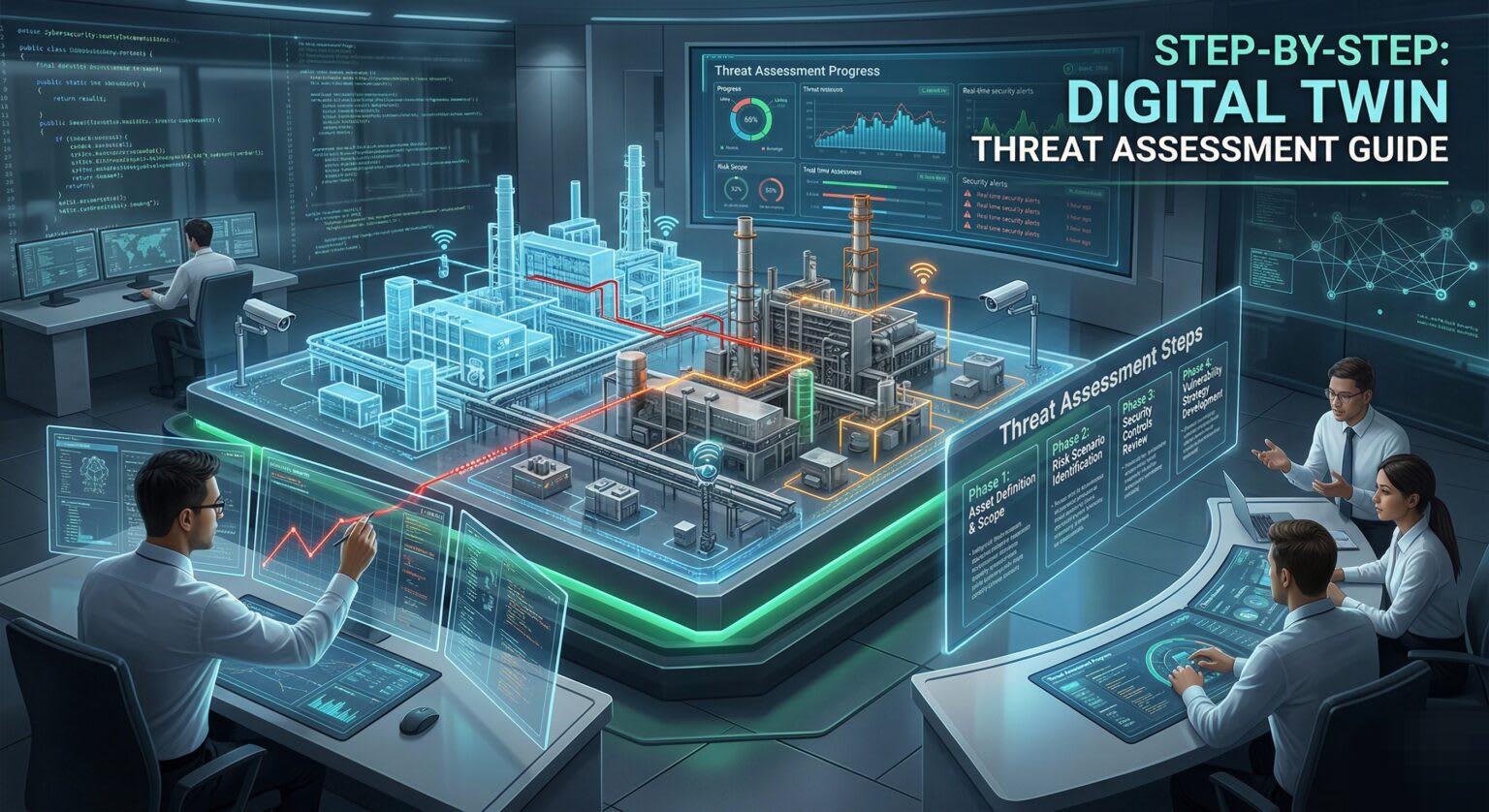
Step-by-Step: Digital Twin Threat Assessment Guide
The following guide is designed for mixed audiences: security engineers will find technical specificity, while executives and managers can use it as a governance framework. It can be applied to any digital twin environment regardless of sector. Work through each step sequentially do not skip ahead, as each step builds on the previous.
Step 1: Inventory Your Twin’s Data Sources
List every data feed entering the twin IoT sensors, SCADA outputs, ERP/MES integrations, cloud APIs and human input interfaces.
- For each source, document: data type, transmission protocol, authentication method and whether data is encrypted in transit.
- Flag any source transmitting over unencrypted channels (HTTP, FTP, plain MQTT) as Critical Risk.
- Assign an owner to each data feed if no one owns a feed, it is unmanaged and must be treated as compromised.
What Good Looks Like: Every data source is documented, encrypted, authenticated (preferably via mutual TLS or certificate pinning) and has a named owner with defined review responsibilities.
Step 2: Map Your Attack Surface
Draw or digitally model every entry point into the twin environment.
- Include: user access interfaces (web portals, APIs, dashboards), service-to-service integrations, cloud provider connections and any physical access points to underlying infrastructure.
- Classify each entry point by exposure level: internet-facing, internal network only or air-gapped.
- Use the MITRE ATT&CK for ICS framework (attack.mitre.org/matrices/ics/) to map realistic adversary techniques to each entry point.
What Good Looks Like: A complete, up-to-date attack surface map reviewed by both IT security and OT/operations teams. Every internet-facing entry point has compensating controls documented.
Step 3: Assess Access Controls and Identity
Review who and what has access to your digital twin and whether that access is appropriate.
- Audit all user accounts: are inactive accounts disabled? Are privileged accounts using MFA?
- Review service accounts and API keys: are any hardcoded in source code or configuration files? Rotate all keys not changed in the past 90 days.
- Apply Role-Based Access Control (RBAC): operators should read sensor data, engineers should configure models, administrators alone should modify access policies.
- Check for shared credentials across systems: a single compromised shared credential in the TRITON attack enabled lateral movement across the entire facility network.
What Good Looks Like: Zero shared credentials. All privileged access requires MFA. Service accounts follow the principle of least privilege. Access is reviewed and re-certified quarterly.
Step 4: Test Data Integrity
Verify that sensor and input data feeding the twin cannot be silently tampered with.
- Implement cryptographic checksums or digital signatures on all sensor data at the point of generation not just at ingestion.
- Establish statistical baselines for all sensor feeds: if a reading falls outside 3 standard deviations of historical norms, trigger an alert and human review before the twin acts on it.
- Simulate a data poisoning attack: inject a subtly manipulated reading into one sensor feed and verify whether your detection systems flag it within an acceptable window.
- For high-criticality twins, consider blockchain-based data provenance logging to create a tamper-evident audit trail.
What Good Looks Like: All sensor data is signed at source. Anomaly detection fires within minutes of a deviation. Simulated poisoning attacks are detected and contained in tabletop exercises.
Step 5: Evaluate IT/OT Network Segmentation
The most dangerous attack paths run from the IT network (corporate) into OT networks (operational) and from there into the digital twin and its physical counterpart.
- Verify that IT and OT networks are separated by more than a single firewall: use a DMZ with a dedicated industrial demilitarized zone (IDMZ) architecture.
- For the highest-risk environments, implement unidirectional security gateways (data diodes) for OT-to-IT data flows, eliminating the possibility of reverse traffic.
- Review firewall rules: are any rules ‘allow any to any’? These must be eliminated. Every permitted connection should have a documented business justification.
- Conduct a simulated lateral movement exercise: can a compromised IT endpoint reach OT systems without triggering an alert?
What Good Looks Like: IT and OT networks are segmented with IDMZ architecture. No IT endpoint can directly initiate connections to OT systems. All OT-to-IT data flows use unidirectional controls in high-criticality environments.
Step 6: Deploy Continuous Monitoring and Anomaly Detection
A digital twin that is not continuously monitored is a liability, not an asset.
- Deploy Security Information and Event Management (SIEM) coverage across all twin components: ingestion pipelines, model servers, output interfaces and access logs.
- Integrate AI-driven anomaly detection that learns normal operational patterns and flags deviations both in data inputs and in user/system behavior.
- Establish detection use cases specific to digital twin environments: sudden changes in sensor data distribution, new API calls to the twin’s configuration interface, unusual output patterns and access from new geographic locations.
- Set mean time to detect (MTTD) targets: aim for under 24 hours for critical twin environments. The IBM benchmark of 199 days is not an acceptable baseline.
What Good Looks Like: SIEM coverage is 100% across all twin components. AI anomaly detection is tuned to the twin’s specific data patterns. MTTD is measured and improving quarter-over-quarter.
Step 7: Conduct Penetration Testing on the Twin – Not Just the Production System
One of the most powerful applications of a digital twin is as a target for aggressive, unconstrained red-team operations.
- Schedule dedicated penetration tests of the digital twin environment at least twice per year, with additional tests after major architecture changes.
- Use the twin to test attack scenarios that could never be safely conducted against production: ransomware propagation, data exfiltration, sensor spoofing and insider threat simulations.
- Share findings with both IT security and OT/operations teams: many vulnerabilities identified in the twin will have direct parallels in the physical system.
- Document and remediate every finding. Track mean time to remediate (MTTR) as a security KPI.
What Good Looks Like: The digital twin is pen-tested at least twice annually. Red-team findings are shared with operations leadership. Remediation rates and MTTR are tracked and reported to the CISO.
Step 8: Build and Test a Cyber-Physical Incident Response Playbook
A digital twin attack may trigger physical consequences before a security team identifies the breach. Standard IT incident response playbooks are insufficient.
- Develop a dedicated playbook for digital twin compromise scenarios covering: detection triggers, immediate isolation procedures, physical system status checks, stakeholder notification and recovery steps.
- Define escalation paths that bridge cybersecurity, OT/operations, executive leadership and external regulators.
- Run tabletop exercises at least annually: simulate a scenario where the digital twin is feeding corrupted data to a physical system and trace the response from first alert to full recovery.
- Ensure the playbook accounts for scenarios where the physical system must be operated manually during twin recovery operators need documented manual override procedures.
What Good Looks Like: A documented, tested cyber-physical incident response playbook exists. Tabletop exercises have been conducted in the past 12 months. Manual override procedures are documented and staff are trained on them.
2. Defense Strategies: Securing the Virtual Replicas
Beyond the threat assessment process, the following strategic investments define a mature digital twin security posture.
2.1 Zero-Trust Architecture
Every user, process and service interacting with a digital twin should be verified and granted only the minimum permissions required. Zero-trust eliminates the assumption that anything inside the network perimeter is safe.
2.2 AI-Driven Anomaly Detection
AI-driven security solutions analyze high volumes of operational data to spot anomalies and potential breaches in near-real time. The WEF (2025) reports AI has reduced breach detection times by 33% and containment times by 43% in SOC environments digital twins can amplify these gains by providing richer contextual data than traditional IT monitoring.
2.3 Secure Data Pipelines and Cryptographic Integrity
Every data feed into a digital twin must be validated, encrypted end-to-end and cryptographically signed at source. Blockchain-based integrity verification is an emerging approach to ensure tamper-evident data provenance for the highest-criticality environments.
2.4 Security-Enhancing Digital Twins (SEDTs)
Researchers Eckhart et al. introduced the concept of SEDTs twins specifically designed to enhance CPS security, allowing users to comprehend past, present and future system behavior without the risk of operational disruptions. This formalizes the use of twins as active security tools rather than passive operational replicas.
Conclusion
The case studies in this article share a single thread: attackers invest deeply in understanding their target’s environment before striking. Digital twins hand them that understanding on a platter unless the organizations that deploy them invest equally deeply in securing them.
The eight-step threat assessment guide in this blog is not a one-time exercise. It is a discipline one that must be revisited as twin architectures evolve, as new threat actors emerge and as the physical systems the twins represent become more deeply integrated with their virtual counterparts.
Organizations that treat digital twin security as an afterthought are making a costly bet against increasingly well-resourced adversaries. The virtual replica is only as safe as the security strategy that surrounds it. Now is the time to build that strategy.
Connect with QuassrCyberTech Experts
Ready to strengthen your organization's security posture?
At QuassrCyberTech, our specialized cybersecurity solutions help organizations stay ahead of evolving risks. From Vulnerability Assessment and Penetration Testing (VAPT) to Security Operations Center (SOC) implementation, Red Team exercises, and Governance, Risk, and Compliance (GRC) frameworks, we provide the expertise and tools needed to secure your digital assets and infrastructure.
Contact us today to develop a customized security strategy for your organization.
References:
SPAC Alliance: IBM Cost of a Data Breach 2025 Report
IEEE Access: A Comprehensive Review on Cybersecurity of Digital Twins (2025)
Springer Nature: Bridging Cybersecurity with Digital Twin Technology (2025)
ACM ARES 2023: Digital Twin-Enhanced Incident Response for Cyber-Physical Systems
World Economic Forum: How Digital Twin Technology Can Enhance Cybersecurity (2025)