
Introduction
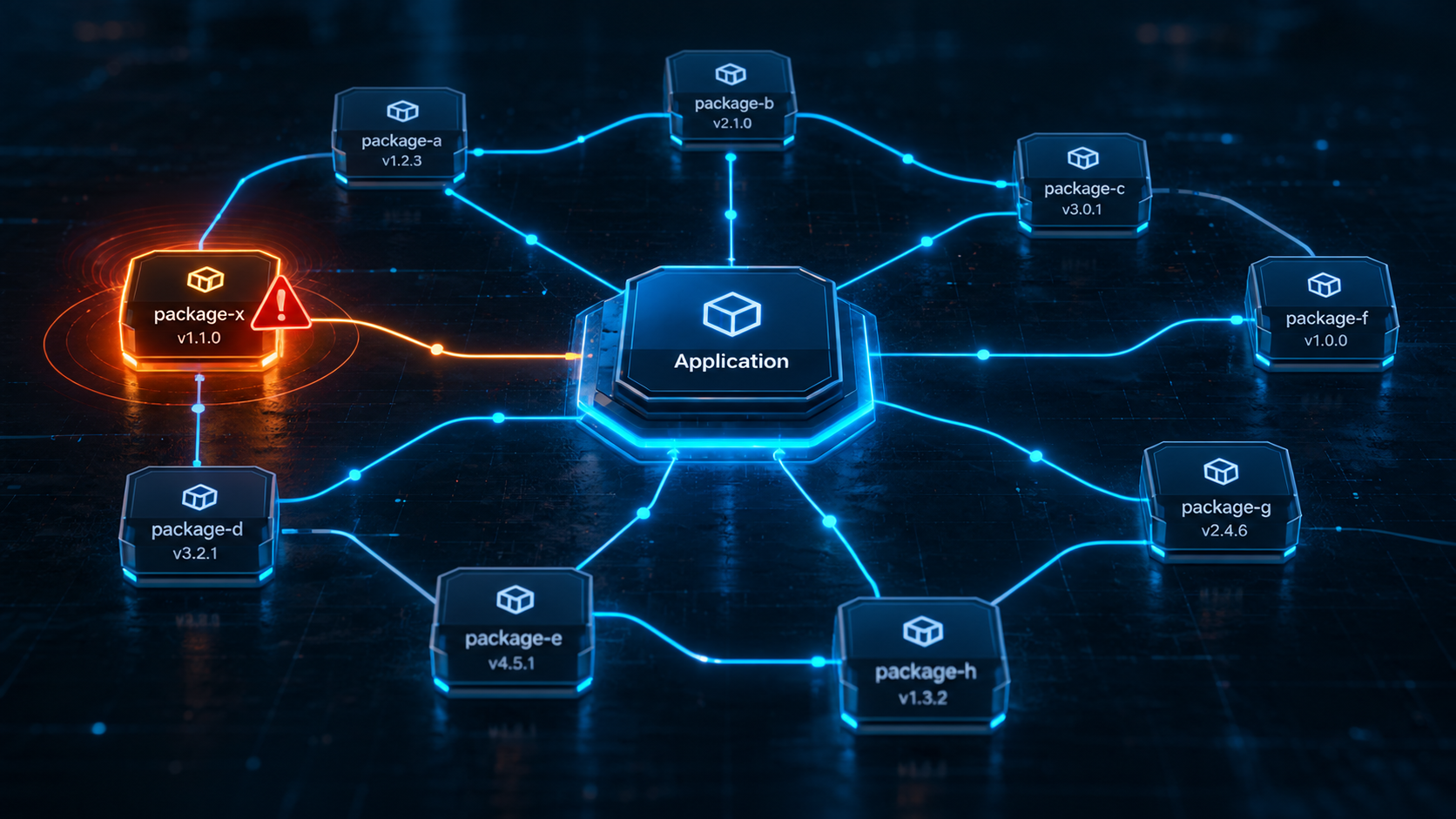
Modern applications are rarely built entirely from scratch. A typical product may rely on open-source libraries, frameworks, package registries, container images, build tools and third-party services. These components help teams deliver features faster, but they also expand the number of places where security problems can enter the software.
A vulnerability in a dependency can affect an application even when the organisation's own code is well written. A compromised package or an unmaintained library can create risk across multiple products at once. This is why software supply-chain security has become an important part of secure software development.
The goal is not to avoid open source. It is to understand what software contains, where each component came from, whether it is maintained, and how quickly the organisation can respond when a component becomes risky.
1. The Hidden Risk Inside Modern Applications
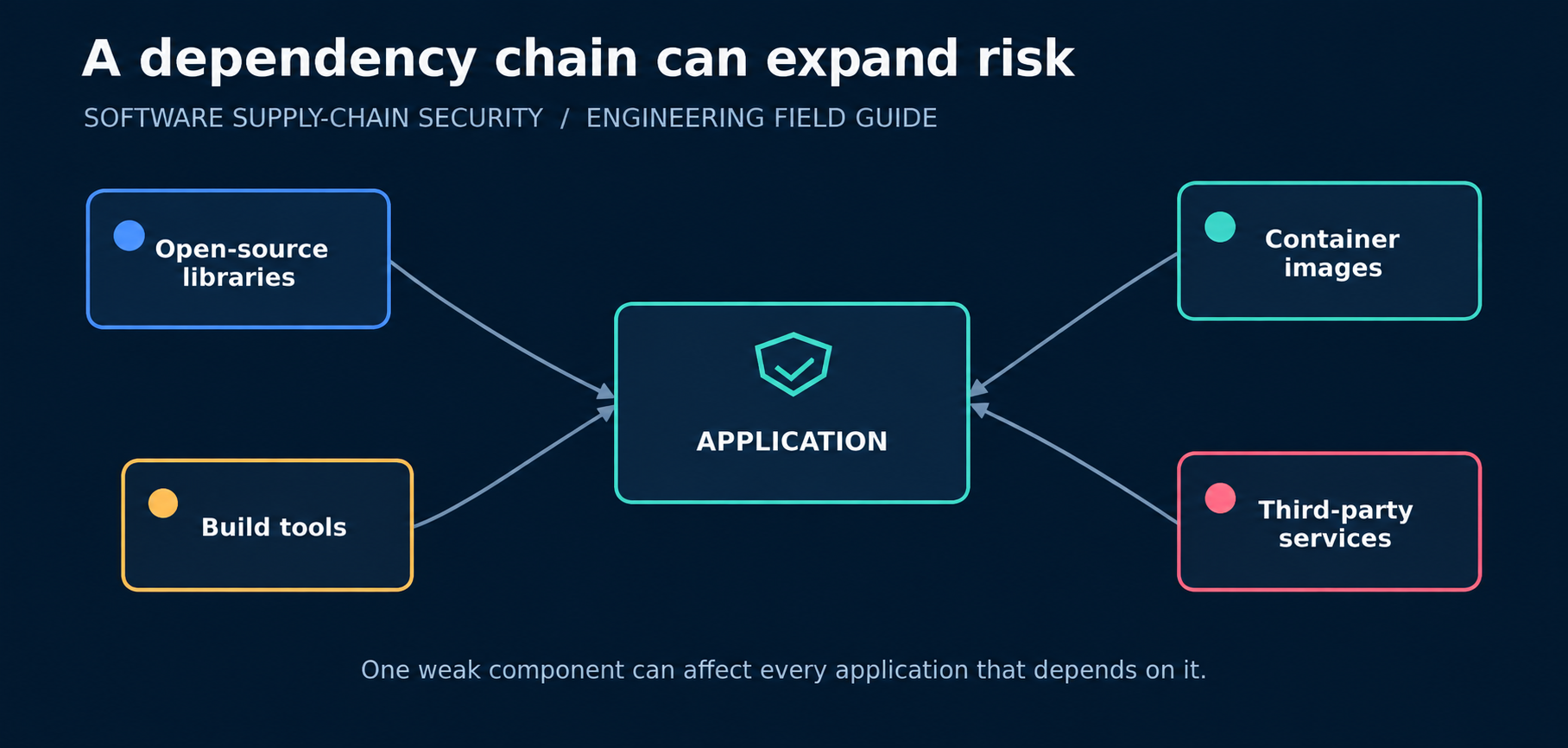
When developers add a library, they often gain much more than the package they selected. That library may bring its own dependencies, which may have further dependencies. This chain can grow quickly and may include components that the team did not consciously evaluate.
Risk can come from several sources: a publicly disclosed vulnerability, a package that is no longer maintained, a malicious or compromised release, an unexpected change in ownership, or a licence that does not fit the organisation's obligations. The risk is not limited to application code - container images, build actions, plugins and deployment tooling can also be part of the supply chain.
Consider a web application that uses a popular logging library. If a vulnerability is later disclosed in the version deployed by the application, the organisation needs to know which services use that version, whether the vulnerable code is reachable, and what upgrade or mitigation is appropriate. Without an accurate component inventory, even answering the first question can take valuable time.
2. Why a Dependency Vulnerability Can Become a Business Problem
A dependency issue can affect availability, confidentiality, integrity, compliance and customer trust. The impact depends on the vulnerable component, how the application uses it, the exposure of the affected service, and whether a practical exploit exists.
A vulnerability alert alone does not prove that an application has been compromised. Teams should validate the affected version, check the advisory and exploit context, determine whether the component is present in a production build, and assess whether the vulnerable functionality is used. At the same time, lack of confirmed exploitation is not a reason to ignore a serious issue.
Supply-chain incidents can also create a multiplier effect: one widely used component may be present across many repositories or products. A central inventory and consistent response process make it easier to find affected systems, assign owners and coordinate remediation.
3. Build an Inventory with a Software Bill of Materials
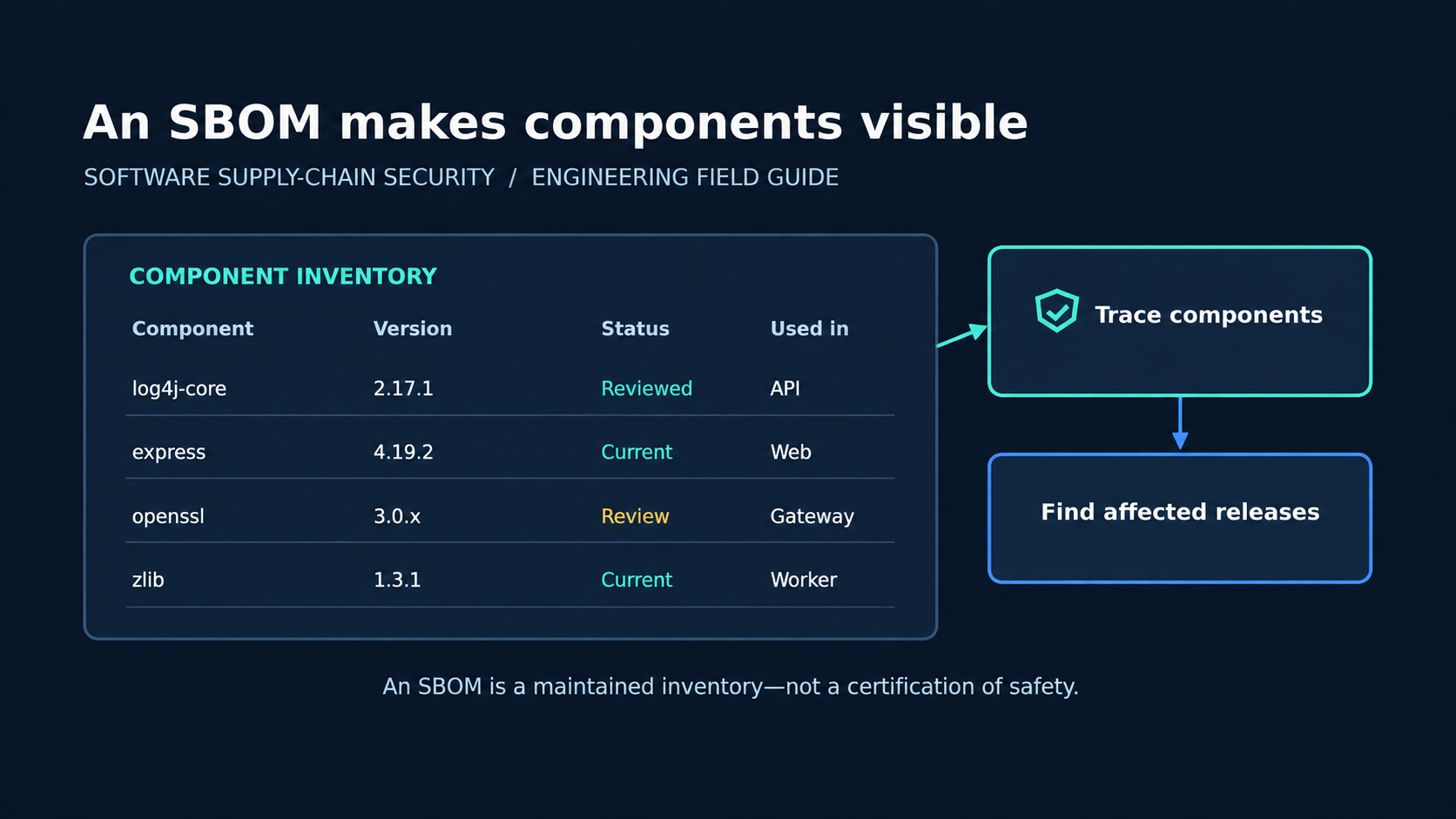
A Software Bill of Materials (SBOM) is a structured inventory of software components. It can record details such as component names, versions, suppliers, relationships and other identifying information. It gives teams a clearer view of what is included in a product and helps them investigate which applications may be affected when a new vulnerability is disclosed.
An SBOM is useful only when it is accurate, tied to the relevant application version, and maintained as software changes. Generating one once and leaving it untouched can create a false sense of visibility. Teams should make SBOM generation part of the build or release process and retain it alongside release records.
An SBOM is not a security certification and does not prove that software is safe. It is an inventory that supports vulnerability analysis, supplier assessment, incident response and compliance work. Its value increases when it is combined with ongoing component analysis and a clear remediation workflow.
4. Use Software Composition Analysis to Find Known Issues
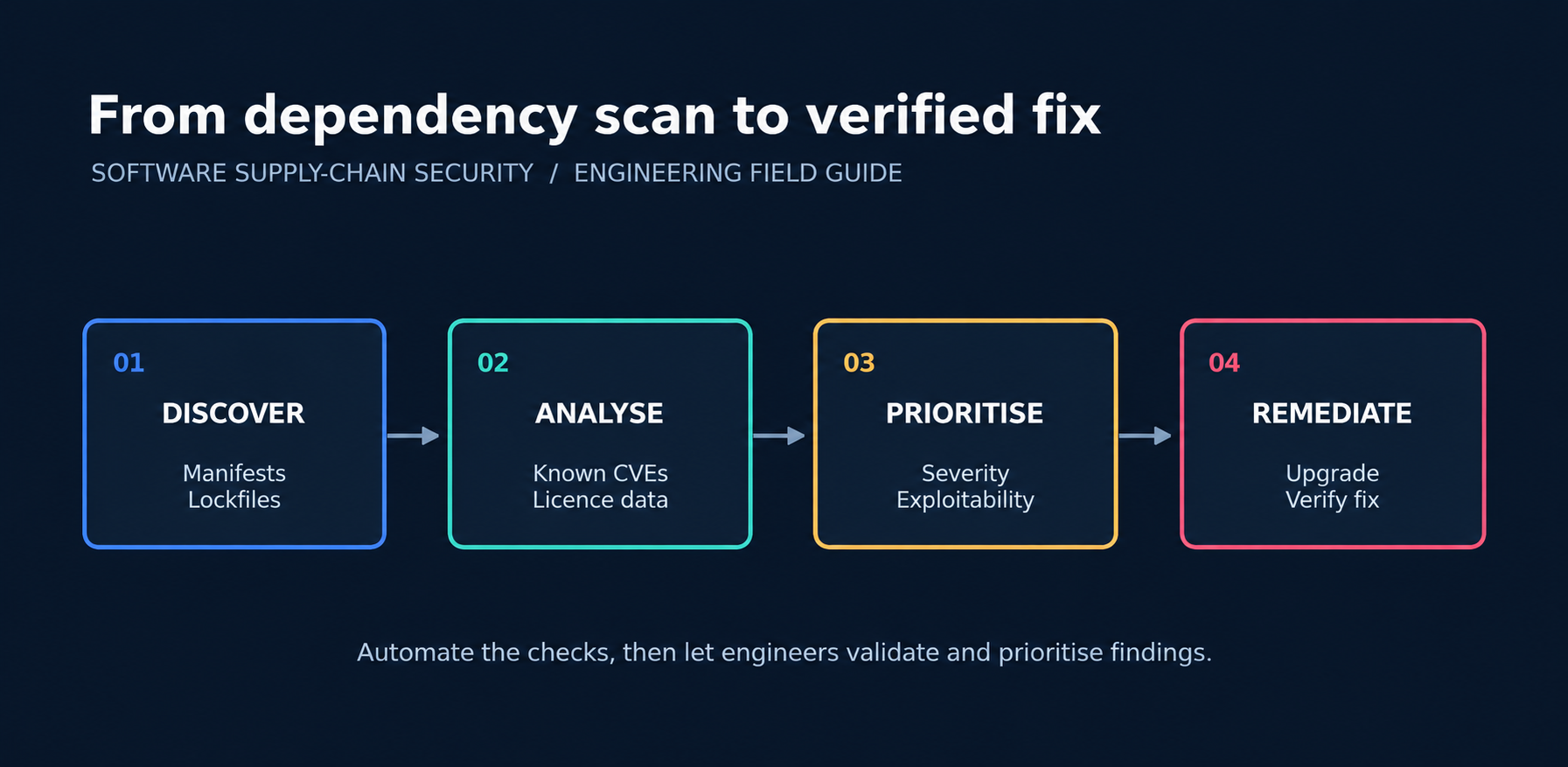
Software Composition Analysis (SCA) tools inspect project manifests, lockfiles, package metadata or built artifacts to identify third-party components and compare them with vulnerability and licence information. They can help teams find known vulnerable versions earlier in development.
Examples include OWASP Dependency-Check, which identifies project dependencies and checks for publicly disclosed vulnerabilities, and OWASP Dependency-Track, which uses SBOM data to track component risk across a portfolio. Trivy is another option that can scan filesystems, dependencies, container images and infrastructure-as-code for several categories of issue.
Tool choice should reflect the languages and package ecosystems in use, the quality of vulnerability data, integration with the existing CI/CD platform, reporting needs and the team's ability to investigate findings. No scanner catches every issue: package identification can be imperfect, advisories can be incomplete, and a clean scan does not establish that the application is secure.
5. Put Dependency Checks into the Development Workflow
Dependency review is most effective when it happens continuously rather than only before a major release. A practical approach is to run scans when code changes, during scheduled checks, and when new vulnerability information becomes available.
A typical workflow can include:
- Identify direct and transitive dependencies from manifests and lockfiles.
- Scan for known vulnerabilities and relevant licence-policy issues.
- Generate an SBOM for each release or build artifact where appropriate.
- Set severity and exploitability criteria for prioritising findings.
- Assign findings to an owner and track remediation to closure.
- Re-scan after upgrades and verify that the fix does not break application behaviour.
Avoid treating every alert as equally urgent. Prioritisation should consider severity, known exploitation, exposure, the role of the component, available fixes and the business importance of the affected service. Define exceptions carefully, document the reason and owner, and review exceptions periodically.
6. Secure the Package and Build Pipeline
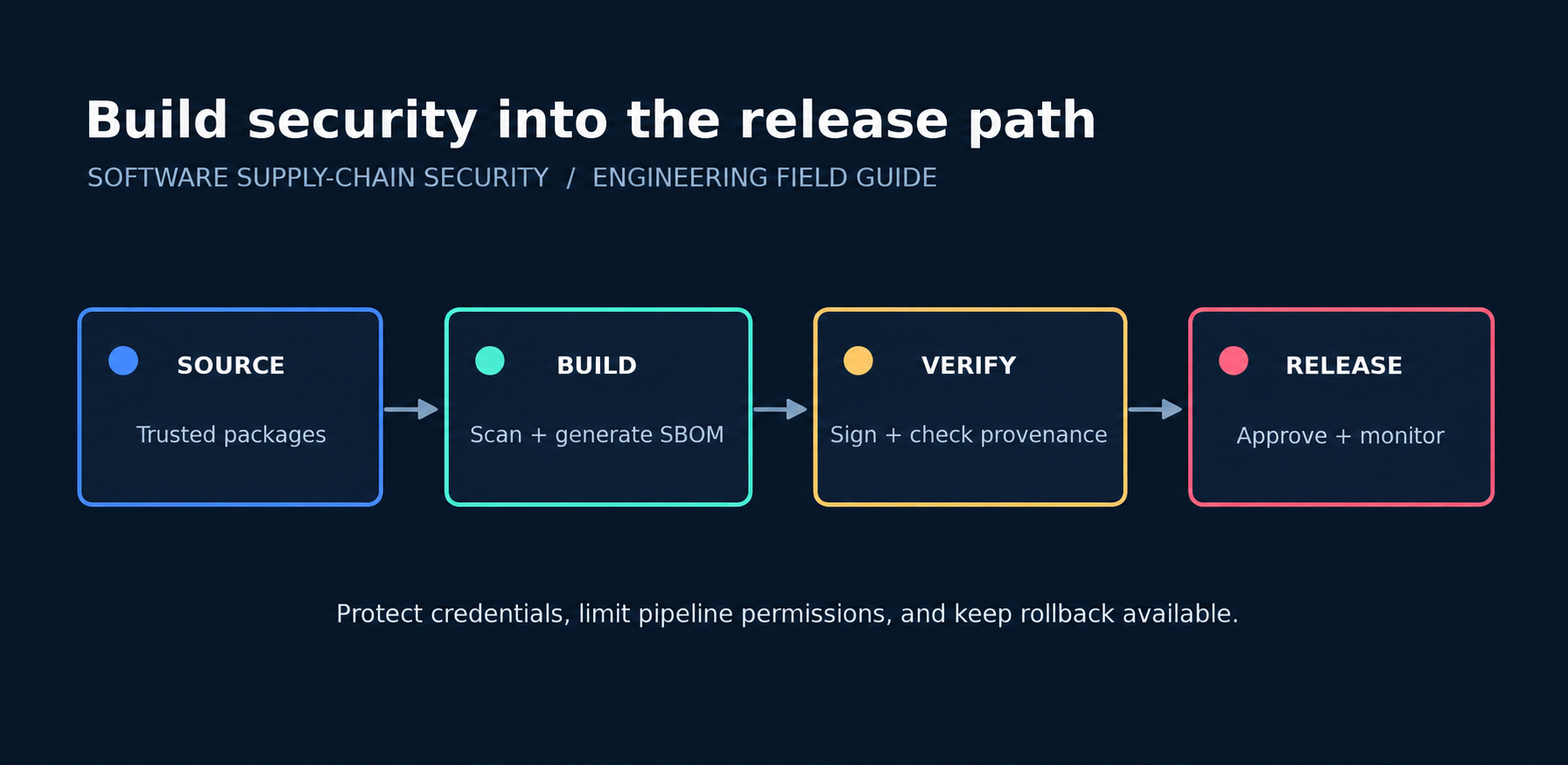
Dependency security is not only about detecting known CVEs. Teams should also reduce the chance of downloading or building with an untrusted component. Use trusted package sources, protect publishing credentials, restrict who can modify build workflows, and review changes to dependencies before they reach production.
Where supported, verify package integrity and provenance, pin critical dependencies to known versions, and use lockfiles consistently. Pinning improves reproducibility but is not a substitute for updates - a pinned vulnerable version still needs to be replaced. Keep build runners and plugins maintained, limit pipeline permissions, and protect secrets from being exposed in logs or build output.
These controls should be proportionate to the application and its risk. A small internal service may need a lighter process than a payment platform or a product used in a regulated environment, but every team benefits from knowing which components it trusts and how those components enter its software.
7. A Practical Checklist for Engineering Teams
- Maintain a current inventory of dependencies for supported applications.
- Generate and retain an SBOM for release versions where appropriate.
- Run SCA checks in CI/CD and on a schedule.
- Define a process for triaging new vulnerability disclosures.
- Prioritise issues using severity, exploitability, exposure and business impact.
- Assign remediation owners and track fixes to completion.
- Use trusted registries and protect build and publishing credentials.
- Review dependency licences and maintenance status.
- Document exceptions, compensating controls and expiry/review dates.
- Test updates before production deployment and keep rollback plans available.
Start with a pilot on one important application. Measure whether the team can identify its components, detect a newly disclosed issue, find affected versions, assign responsibility and verify a fix. Expand the process once the workflow is reliable.
Conclusion: Visibility Makes Response Possible
Modern software depends on a network of components maintained by many different teams and organisations. That reuse is one of the strengths of software engineering, but it means application security cannot stop at reviewing code written in-house.
A current component inventory, automated composition analysis, protected build processes and a clear remediation workflow help teams move from uncertainty to informed action. The objective is not to eliminate every dependency risk. It is to know what is in the software, understand which risks matter most, and respond before a manageable issue becomes a business disruption.
Connect with QuassrCyberTech Experts
Ready to strengthen your organization's security posture?
At QuassrCyberTech, our specialized cybersecurity solutions help organizations stay ahead of evolving risks. From Vulnerability Assessment and Penetration Testing (VAPT) to Security Operations Center (SOC) implementation, Red Team exercises, and Governance, Risk, and Compliance (GRC) frameworks, we provide the expertise and tools needed to secure your digital assets and infrastructure.
Contact us today to develop a customized security strategy for your organization.
References
- OWASP Developer Guide - Dependencies
- OWASP Vulnerable Dependency Management Cheat Sheet
- CISA - 2026 Minimum Elements for a Software Bill of Materials (SBOM)
- OWASP DevSecOps Verification Standard - Software Composition Analysis